The suitcase wheel decision looks simple until you’re dragging a heavy bag through a crowded airport or pulling it over broken sidewalks at 11pm in a city you don’t know.
A 4-wheel spinner feels effortless on smooth floors, but a 2-wheel roller can survive places where spinners struggle. Get it wrong and you’re stuck with a $200 mistake for the next five years of trips.
This guide breaks down the real tradeoffs — including a few things most “wheel count” articles skip entirely.
Quick Answer
For most travelers: choose a 4-wheel spinner. It’s easier to handle in airports, hotels, train stations, and on city sidewalks — which is where most trips actually happen.
Choose a 2-wheel suitcase if:
- You regularly walk long distances with your bag
- You travel through cobblestone or old-town cities
- You’re frequently on uneven or unpaved roads
Our Quick Picks
| Suitcase | Wheels | Best For | |
|---|---|---|---|
| Samsonite Lite-Shock Spinner | 4-Wheel | Frequent flyers, lightweight premium travel | Check Price |
| Amazon Basics 21″ Hardside Carry-On | 4-Wheel | Best-selling budget spinner, expandable | Check Price |
| Eastpak Tranverz | 2-Wheel | Flexible sizing, soft-shell travelers | Check Price |
| U.S. Traveler Rio Softside Carry-On | 2-Wheel | Budget-friendly, family travel | Check Price |
Full breakdowns, including “best for” and “avoid if” notes, are further down in this guide.
4-Wheel vs 2-Wheel: Quick Comparison
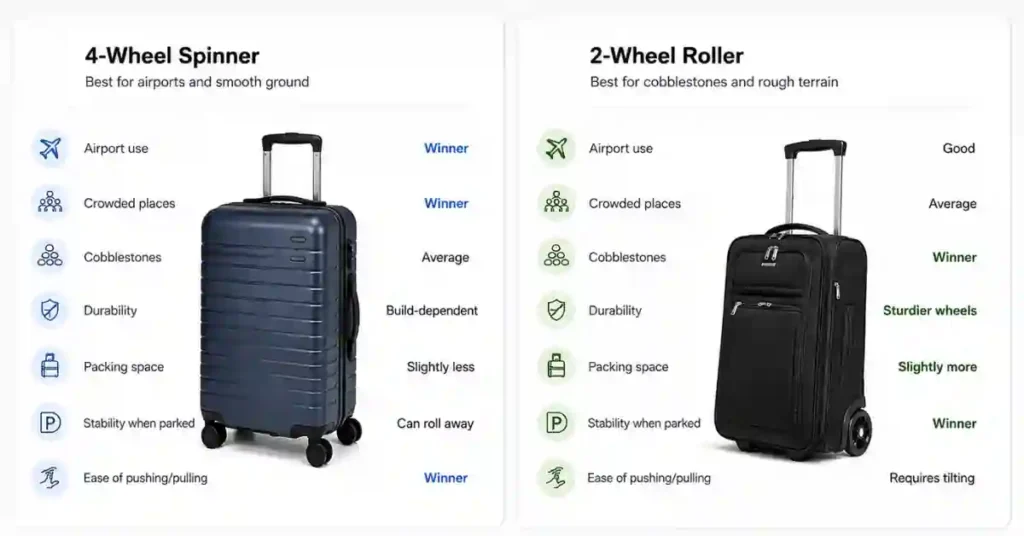
4-Wheel Suitcases
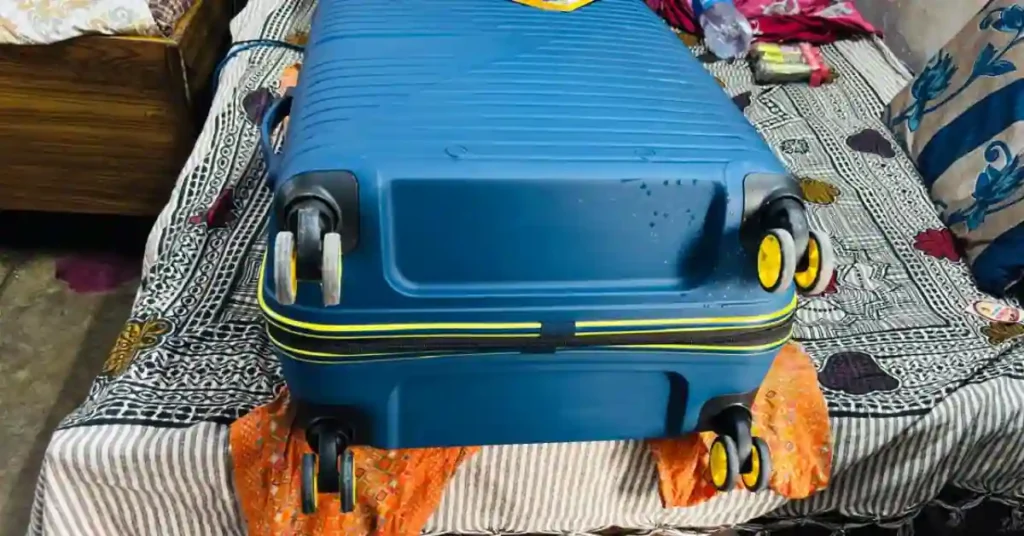
4-wheel suitcases, often called spinners, are the most popular choice for travelers today. Their biggest selling point is how easy they are to handle: the wheels rotate a full 360 degrees, so you can roll the case upright beside you instead of tilting and dragging it behind you.
That makes it much easier to steer around tight corners, squeeze through narrow aisles, or weave through a busy terminal.
Spinners also dominate the market. There’s a far wider selection of models, sizes, and price points than with 2-wheel cases. The luggage market has shifted heavily toward 4-wheel spinner designs, especially for modern hard-shell suitcases.
Why Choose a 4-Wheel Suitcase
- Easy to move in any direction, with minimal arm and shoulder strain
- Can walk beside your bag instead of behind it (fewer ankle-clips, less annoyance to people behind you)
- Widest range of sizes, designs, and price points
The Real Downsides
- On cobbled streets, gravel, or uneven pavement, the small wheels can be harder to control over longer distances, especially fully packed
- Spinners can roll away on their own if left on a slope, a train platform, or even a slightly uneven floor — always keep a hand on it
- The wheels sit exposed outside the frame, which makes them more vulnerable to impact damage during handling (more on this below)
Best 4-Wheel Spinner Suitcases
Samsonite Lite-Shock Spinner — Built with Curv® material, this shell is lightweight but shock-resistant, absorbing impact around the corners where suitcases usually take the most damage.
The cabin size weighs around 5.51 lb, so you’re not wasting weight allowance on the case itself, and the four spinner wheels glide easily through airports and hotel lobbies.
Best for: frequent flyers who want lightweight, premium luggage with strong impact protection. Avoid if: you regularly walk on rough streets or unpaved ground.

Amazon Basics 21″ Hardside Carry-On — Measures 14.9 x 10 x 21.6 inches (including wheels) with a 39L capacity and weighs about 6.9 lbs.
The extra-thick, scratch-resistant hard-shell expands up to 25% for extra packing space, and it rolls on four multi-directional spinner wheels with a telescoping handle. At around $65, it’s a low-risk way to try the spinner format without a big investment.
Best for: budget-conscious travelers who want a proven, widely-reviewed spinner.
Avoid if: you’re a frequent flyer who needs premium-grade wheel durability over years of heavy use.

For more carry-on-specific sizing details, see our Suitcase Size Guide and our Best TSA Approved Carry-On Luggage guide.
2-Wheel Suitcases
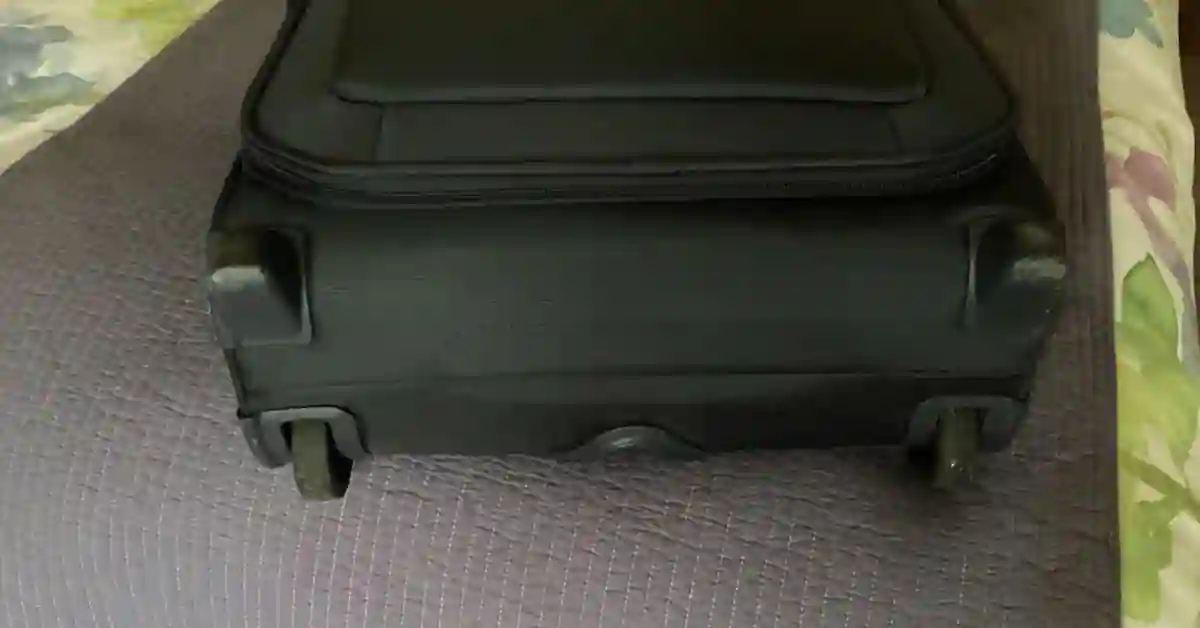
2-wheel suitcases are less common now, but still offer real advantages. Their wheels are usually larger than spinner wheels, which makes them easier to pull across rough ground like gravel or cobblestone, and their design tucks the wheels into the frame — meaning they’re better protected from impacts.
Advantages of 2-Wheel Suitcases
- Bigger, tougher wheels that handle uneven surfaces better
- Wheels are recessed into the frame, so they’re less exposed to damage
- Stay upright and steady when parked — no rolling away
- Slightly more usable interior volume (see below)
The Real Downsides
- You always have to tilt the case onto two wheels to move it, which means lifting one end and pulling — tiring over long distances, and it puts more strain on your arm than pushing
- Fewer models to choose from, especially in larger, hard-shell sizes
- Trails behind you, which can trip people (or you) in crowded spaces
Best 2-Wheel Suitcases
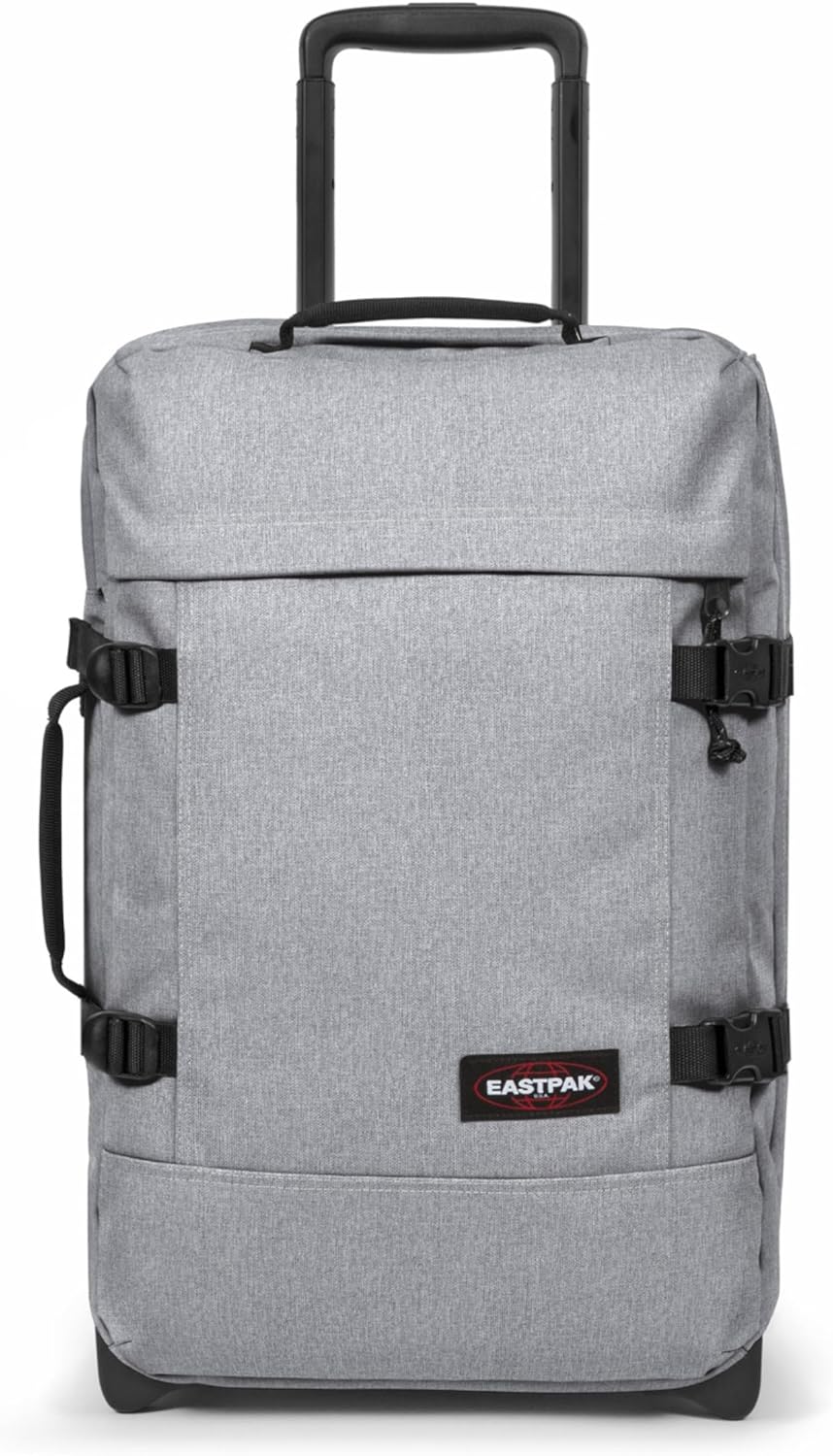
Eastpak Tranverz — A soft-shell standout with two large inline wheels that roll smoothly whether you’re pulling it across long airport corridors or uneven pavement.
It comes in four sizes, giving you more flexibility than most 2-wheel models offer, along with a roomy interior and lightweight build.
Best for: travelers who want a flexible size range and a soft-shell single-compartment layout.
Avoid if: you prefer the structure and impact protection of a hard shell.
U.S. Traveler Rio Softside Carry-On — A wallet-friendly 2-wheel option built from dense 1200D polyester with corner-protected inline wheels and a multi-stage telescoping handle.
The interior is fully lined with mesh zip pockets and compression straps, and it expands by 2 inches for last-minute packing. At around $45, it’s one of the most affordable ways to get a real 2-wheel case rather than a converted spinner.
Best for: budget travelers and families who want simple, reliable 2-wheel luggage without a premium price tag.
Avoid if: you need the bigger, more rugged wheels of a purpose-built outdoor case like the Osprey below.

If you want more rolling options that lean toward rugged, all-terrain use rather than airport polish, our Best Checked Luggage guide covers several tested picks.
The Tilt Trick: You Might Not Need to Choose
Here’s the thing most comparison guides leave out: almost every 4-wheel suitcase can be tilted back and dragged on its rear two wheels, just like a 2-wheeler.
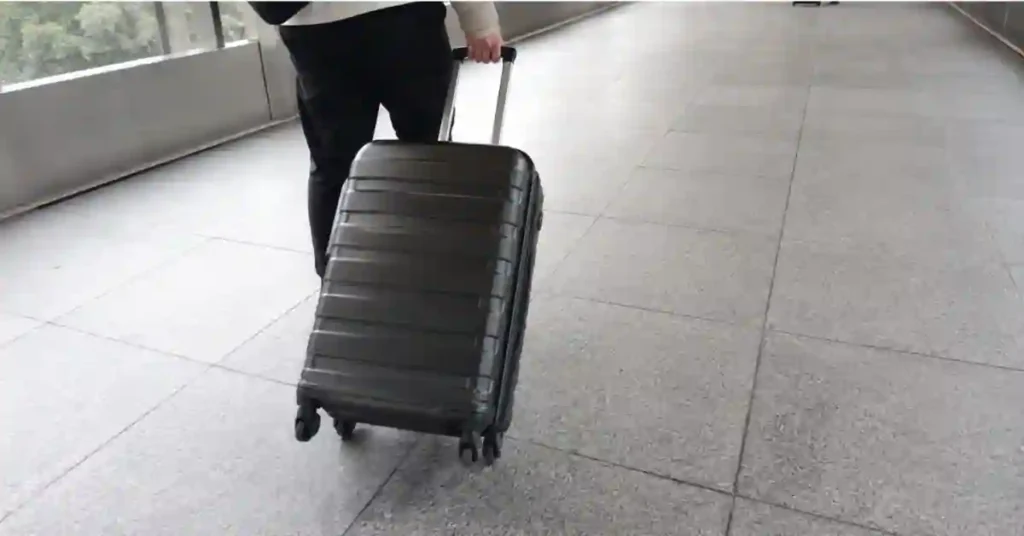
Frequent travelers who deal with a mix of smooth airport floors and rough cobblestone streets do this constantly — glide on all four wheels where the ground is smooth, tilt back to two wheels the moment it isn’t.
This doesn’t make 4-wheelers equal to 2-wheelers on rough terrain (2-wheelers still tend to have larger, sturdier wheels built for exactly that job), but it does mean the “4-wheel suitcases are unusable on cobblestones” claim is overstated.
In practice, most people report that a well-built spinner handles occasional rough patches just fine using this trick — it’s sustained rough terrain, not the odd stretch of cobblestone, where it really struggles.
8 Wheels vs 4 Wheels: Is More Better?
You’ll see some suitcases marketed as “8-wheel” or “double-spinner” models, and it’s worth knowing what that actually means before you pay extra for it.
In almost every case, an “8-wheel” suitcase is simply a 4-wheel spinner where each corner uses a pair of smaller wheels instead of one — so it’s still a 4-wheel design at its core, just doubled up.
The benefit is a smoother, quieter roll and slightly better durability, since the load is spread across twice as many contact points.
But it doesn’t change the fundamental tradeoffs covered in this guide: it’s still a spinner, still best suited to smooth ground, and still more exposed to impact damage than a 2-wheel case with recessed wheels. Think of 8 wheels as a refinement of the 4-wheel category, not a third option.
Durability: It’s Not Really About Wheel Count
The most common failure point on any suitcase is the wheels — but why they fail differs by design:
- 4-wheel spinners have wheels that protrude outside the case’s footprint. That makes them more exposed to being caught on conveyor belts, baggage nets, or curbs, and airline baggage handlers moving quickly can snap them off.
- 2-wheel cases recess the wheels into the frame, which shields them from most of that impact — but the wheels still wear down faster if dragged over sustained rough terrain.
In both cases, build quality and repairability matter more than the wheel count itself. A cheap 4-wheeler and a cheap 2-wheeler will both eventually fail.
A well-built one of either type, from a brand with an easy parts-replacement policy, will outlast a “better” design from a brand that doesn’t support repairs.
If wheels are your top concern, prioritize a brand that sells replacement wheels and has a straightforward warranty process over the wheel count itself.
If you’re weighing a hard-shell spinner set instead of a single case, our Lightweight Luggage Sets guide breaks down which multi-piece sets hold up best to this kind of wear.
Capacity: A Small but Real Difference
2-wheel cases tend to have a modest capacity edge because they don’t need wheel wells cut into the base.
For comparable models in the same product line, the difference is typically in the range of a few percent — noticeable if you’re packing to the limit, but not the dramatic “way more room” some sellers imply.
Weigh this against the 4-wheeler’s maneuverability before assuming extra capacity should be the deciding factor.
Other Things Nobody Mentions
- Rolling away: Spinners can roll off unattended on any slope — a train platform, a ramp, even a slightly sloped sidewalk. Get in the habit of parking them against something or holding on.
- Noise: Dragging a 4-wheeler on hard, uneven ground can be surprisingly loud and grating over a long walk — worth testing in-store if this bothers you.
- Shell type interacts with wheel choice: hard-shell spinners often have a center zipper that splits the case into two heavy halves, which some travelers find awkward to pack and repack compared to a single-compartment soft-shell duffel-style 2-wheeler.
When Should You Use a 2-Wheel Suitcase?
A 2-wheel suitcase shines when you’ll be walking long distances or dealing with sustained uneven terrain — old-town cobblestone streets, gravel paths, or cities where sidewalks aren’t well maintained.
If you’re doing a lot of city-to-city travel by train through areas like this, a 2-wheeler (or a spinner you’re willing to tilt often) is worth considering.
When Should You Use a 4-Wheel Suitcase?
If you’re mostly moving through airports, train stations, hotels, and paved city streets, a spinner is the easier day-to-day choice — less arm strain, easier one-handed control, and a much bigger selection of models and sizes.
Real Traveler Scenarios
Sometimes it’s easier to decide by matching your actual trip, not just the terrain in the abstract.
Scenario 1: Frequent Flyer Airport → taxi or rideshare → hotel lobby → repeat. Winner: 4-wheel spinner. Almost every surface in this loop is smooth, and the ability to push the case one-handed while checking your phone or holding a coffee is worth a lot on a tight connection.
Scenario 2: Europe Train Trip Train station → cobblestone old town → walk-up Airbnb with no elevator. Winner: 2-wheel roller. The bigger, recessed wheels hold up better over sustained rough ground, and you’ll be doing more walking-and-pulling than gliding through a terminal.
Scenario 3: Family Travel Multiple bags, kids in tow, moving fast through crowded terminals and parking structures. Winner: 4-wheel spinner. One-handed pushing frees up your other hand for a kid, a stroller, or a second bag — the mobility tradeoff on rough ground matters less when you’re rarely far from pavement.
Conclusion: 2 Wheels or 4 Wheels?
There isn’t one universal answer — but there is a more useful way to decide than just counting wheels:
- If your travel is mostly smooth ground (airports, train platforms, city sidewalks), get a 4-wheel spinner and use the tilt trick on the occasional rough patch.
- If you’re regularly on sustained rough terrain (old towns, gravel, poorly maintained sidewalks), a 2-wheeler’s bigger, better-protected wheels will save you wear and tear.
- Either way, prioritize build quality and repairability over wheel count. A well-made suitcase with available replacement parts and a real warranty will outlast a “better” design from a brand that won’t fix it when something breaks.
Frequently Asked Questions
What’s the main disadvantage of spinner (4-wheel) luggage?
It struggles more on rough or uneven ground, and because it rolls in every direction, it can roll away if left unattended on a slope. Tilting it back onto two wheels solves most of the rough-terrain issue.
What’s the best suitcase type for flying?
A lightweight hard-shell 4-wheel carry-on is the easiest choice for most flying — it’s simple to maneuver through terminals and fits overhead bins well. A 2-wheeler is a solid alternative if you want slightly more packing space.
When should I use a 2-wheel suitcase?
When you’ll be walking long distances over uneven terrain — cobblestones, gravel, poorly maintained sidewalks — where the bigger, frame-protected wheels hold up better.
Is an 8-wheel suitcase better than a 4-wheel?
Most “8-wheel” cases are just four double-wheel spinner sets. They roll a bit more smoothly and durably, but the core experience is the same as a good 4-wheel case — think of it as an upgrade, not a different category.
Are 4-wheel suitcases better than 2-wheel overall?
Not universally — it depends on where you’ll actually use it. Spinners win on smooth ground and ease of handling; 2-wheelers win on rough terrain and stability when parked. Build quality and repairability matter more than the wheel count in either case.