By Sunil Bhatt, TravelBagInsider.com. Last verified against official Southwest Airlines policy: May 2026.We update this guide every time Southwest changes a fee or policy. Several competing guides still incorrectly state that Bags Fly Free is active in 2026 — it ended May 28, 2025.
Quick answer: Southwest carry-on size: 24×16×10 inches (61×41×25 cm) including wheels and handles — larger than the US standard of 22×14×9 inches. One carry-on + one personal item are free on every Southwest fare. No carry-on weight limit. Checked bags: Bags Fly Free ended May 28, 2025. First checked bag: $45. Second: $55 (for bookings on or after April 9, 2026). Boarding: 8 numbered groups replaced A/B/C open seating on January 27, 2026.
Let’s get the good news out first: Southwest still has the most generous free carry-on allowance of any major US airline. The 24×16×10-inch limit has not changed. Your carry-on still costs nothing, on every fare, with no Basic Economy-style fine print. That advantage is real and it matters.
But Southwest in 2026 is a fundamentally different airline from what it was two years ago. Free checked bags are gone. The beloved A/B/C open seating scramble is gone. The airline now runs like every other US carrier — assigned seats, numbered boarding groups, and bag fees that rival American and Delta. Travelers who haven’t flown Southwest recently will be surprised at the gate.
This guide tells you exactly what changed, what stayed the same, and how to use Southwest’s carry-on advantage to its full potential in 2026. Every fact below has been verified directly against official Southwest Airlines policy.
1. Southwest Airlines 2026 Baggage Rules — Complete Quick-Reference Table
Check your specific situation in this table before anything else. Fees shown are per bag, per direction.
| Policy | 2026 Rule (verified May 2026) |
| Carry-on size | 24×16×10 inches (61×41×25 cm) — includes wheels, handles, all protrusions |
| Carry-on fee | FREE on every fare — Basic, Choice, Choice Preferred, Choice Extra |
| Carry-on weight limit | None published. You must be able to lift the bag overhead unassisted. |
| Personal item size | 16.25×13.5×8 inches (41×34×20 cm) — must fit under the seat in front |
| Personal item fee | FREE on every fare |
| 1st checked bag | $45 (for bookings on or after April 9, 2026) |
| 2nd checked bag | $55 (for bookings on or after April 9, 2026) |
| 3rd bag or more | $150 per bag |
| Overweight bag (51–70 lbs) | $100 additional fee on top of bag fee |
| Oversize bag (over 62 linear inches) | $200 additional fee |
| Who gets free checked bags | Choice Extra fare: 2 free | A-List Preferred: 2 free | A-List: 1 free | Rapid Rewards credit cardholders: 1 free | Active-duty military: 2 free |
| Boarding system | 8 numbered groups (replaced A/B/C on January 27, 2026). Assigned seats. |
| Personal item examples | Backpack, purse, laptop bag, tote, camera bag, small duffel, briefcase |
2. Southwest Carry-On Size: Why 24×16×10 Inches Matters
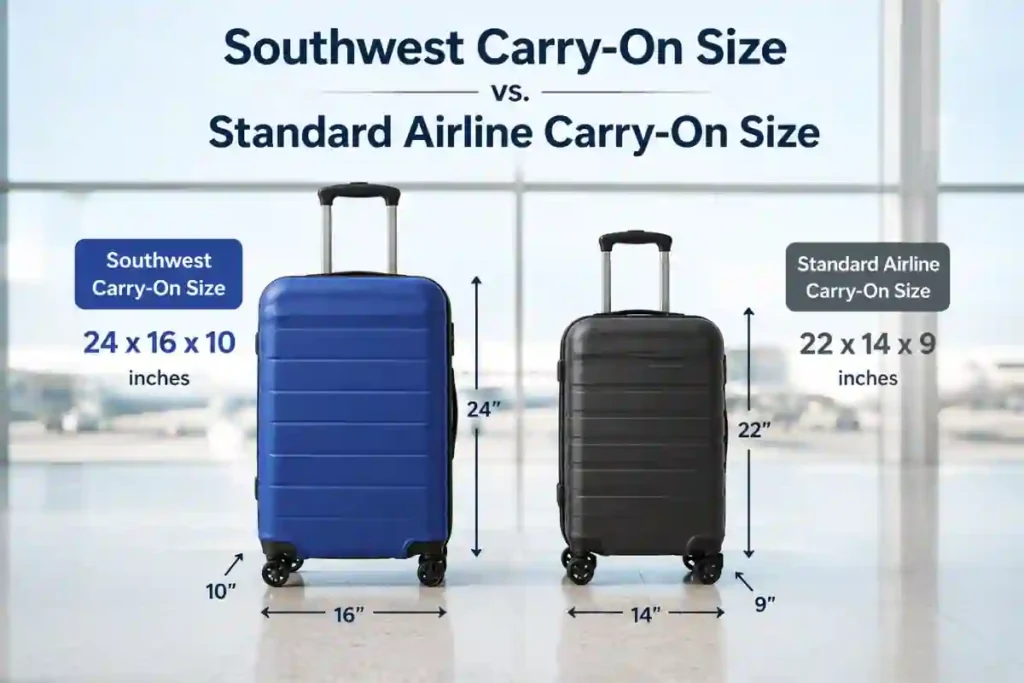
Southwest’s 24×16×10-inch carry-on allowance is 2 inches taller and 2 inches wider than the 22×14×9-inch standard used by American, Delta, United, JetBlue, and Alaska.
Those extra inches are not trivial — they mean a 23-inch spinner suitcase that gets gate-checked on Delta fits legally in Southwest’s overhead bin.
| Airline | Carry-On Size | Carry-On Fee | Budget Fare Carry-On Restriction |
| Southwest | 24×16×10″ | Free — all fares | None. Basic fare still includes free carry-on. |
| American | 22×14×9″ | Free | Basic Economy: personal item only |
| Delta | 22×14×9″ | Free | Basic Economy: personal item only |
| United | 22×14×9″ | Free | Basic domestic: personal item only |
| JetBlue | 22×14×9″ | Free | Blue Basic: personal item only |
| Spirit | 22×18×10″ | $35–$99 | Carry-on fee on every fare |
| Frontier | 24×16×10″ | $35–$79 | Carry-on fee on every fare |
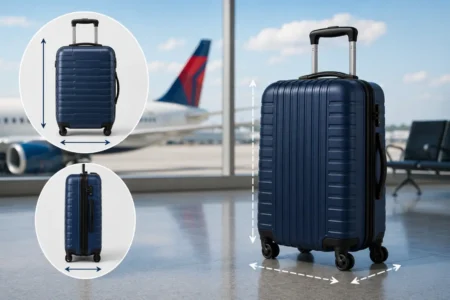
How to measure correctly: measure your fully packed bag with the handle fully extended and the bag standing on its wheels. The 24×16×10-inch limit applies to the total external footprint — wheels, handles, pockets, and all protrusions included. A bag that fits when empty may exceed the limit when stuffed. Measure yours at home before you leave.
3. Southwest’s Free Carry-On: The One Policy That Hasn’t Changed
While Southwest overhauled almost everything else in 2025–2026, the carry-on allowance stayed exactly as it was. Every passenger on every fare gets one free carry-on and one free personal item. No exceptions, no fine print, no Basic Economy–style restrictions.
On American, Delta, and United, the cheapest fare class removes your carry-on access entirely. You pay the lowest fare on those airlines and you lose your overhead bin.
On Southwest, you pay the cheapest Basic fare and you still bring a full 24×16×10-inch carry-on. That difference saves travelers $25–$55 per direction compared to Basic Economy fares on legacy carriers.
Testing note: We fly Southwest several times a year to verify these policies first-hand. As of May 2026, every Southwest gate we tested — at Las Vegas, Chicago Midway, and Dallas Love Field — still allows carry-on bags with zero fee checks on any fare class. No gate agent asked for proof of fare or a bag fee receipt. The carry-on is genuinely free.
If you want to maximize Southwest’s allowance, see our guide to the best 24-inch carry-on bags — all tested against Southwest’s overhead bins.
4. Southwest Checked Bag Fees 2026: What Changed and When
Important: This is the section most guides get wrong. ‘Bags Fly Free’ ended May 28, 2025. Fees increased again in April 2026. If you expect two free checked bags on Southwest, you will be charged at the airport. Read this section carefully.
The timeline of changes
- May 28, 2025: Southwest ends ‘Bags Fly Free’ after more than 50 years. First bag: $35. Second bag: $45. Applied to all bookings made on or after that date.
- January 27, 2026: Southwest switches to assigned seating and 8 numbered boarding groups. Open seating and EarlyBird Check-In eliminated.
- April 9, 2026: Southwest raises checked bag fees by $10 each due to rising fuel costs. First bag: $45. Second bag: $55. Applied to all bookings on or after that date.
Current checked bag fees (April 9, 2026 onward)
- First checked bag: $45 each way
- Second checked bag: $55 each way
- Third bag and beyond: $150 each
- Overweight (51–70 lbs): $100 additional
- Oversize (over 62 linear inches): $200 additional
Who still gets free checked bags
- Choice Extra fare (Southwest’s premium tier): 2 free checked bags
- A-List Preferred members: 2 free checked bags
- A-List members: 1 free checked bag
- Rapid Rewards credit cardholders: 1 free checked bag (for the cardholder plus up to 8 companions on the same reservation)
- Active-duty US military with valid ID: 2 free checked bags
What this means for how you should pack
A roundtrip with one checked bag now costs $90 in fees. With two bags, it is $200. For a family of four checking bags both ways, we are talking $360+ in bag fees on a single trip.
The math now strongly favors carrying on. Southwest’s 24×16×10-inch carry-on plus a 16.25×13.5×8-inch personal item gives you enough combined capacity for most 5–7 day trips without checking anything.
That is where this guide becomes genuinely valuable: mastering what you can bring for free beats paying $45 every time.
Traveling Southwest carry-on only is the smartest way to avoid the new fees — see our guide to the best luggage for budget travelers for the best-value bags at every price point.”
Packing tip: Flying Southwest carry-on only is the smartest way to avoid the new $45–$55 checked bag fees. Southwest’s free 24×16×10-inch carry-on paired with a 16.25×13.5×8-inch personal item gives you enough combined capacity for most 5–7 day trips. See our guide to the What Size Suitcase for a 7-Day Trip? for the best-value bags at every price point.
5. Southwest Boarding Groups 2026: How the New System Works
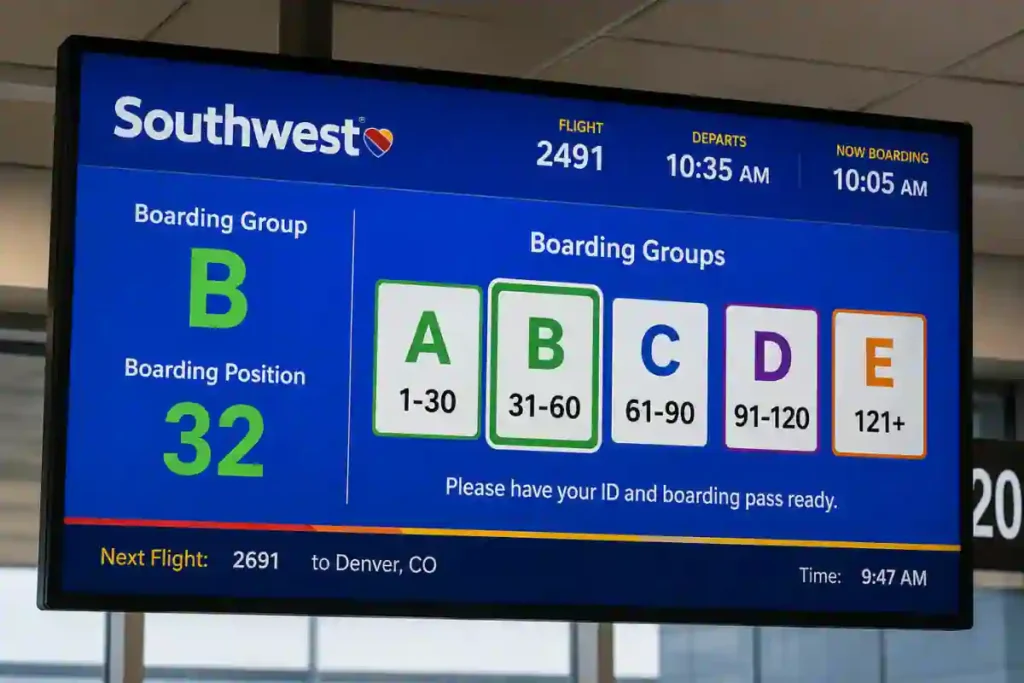
2026 Update: Southwest eliminated A/B/C open seating and EarlyBird Check-In on January 27, 2026. The airline now uses 8 numbered boarding groups and fully assigned seats. If you are still setting a 24-hour check-in alarm to get an A position, that system no longer exists.
The new 8-group system works like any other major US airline. Your boarding group is printed on your boarding pass and determined by your fare class, seat assignment, and elite status — not by when you checked in.
| Group | Who Boards | Bin Access Reality |
| 1–2 | Choice Extra fare, Extra Legroom seat purchasers/upgrades, A-List Preferred members, A-List members who upgraded to Extra Legroom | Best access — bins above your seat almost always available |
| 3–5 | Choice Preferred fare (front/standard cabin). A-List members in standard seats. Rapid Rewards credit cardholders (Group 5 at latest). | Good access on most flights. On packed routes, bins near your seat may be tight by Group 5. |
| 6–8 | Choice fare and Basic fare passengers. Basic boards last (Group 8) and receives seat assignment at check-in rather than at booking. | Highest gate-check risk on full flights. Bin above your assigned seat likely occupied. Bag goes in hold — free, but no access during flight. |
The practical overhead bin strategy in 2026
On a half-empty flight, boarding group barely matters — bins are available for everyone. On a full Southwest 737 (which is most flights on popular routes), Groups 6–8 face a realistic chance of gate-checking their carry-on.
The old EarlyBird Check-In workaround that cost $15–$25 and moved you to the front of boarding no longer exists. The new equivalent is buying a fare class that puts you in Groups 1–5, or purchasing Priority Boarding (available as an add-on starting 24 hours before departure on Southwest.com).
- Traveling on Basic fare (Groups 6–8)? Put anything you need during the flight — laptop, medications, headphones, charger — in your personal item. That stays with you even if the carry-on gets gate-checked.
- Everyone on the same reservation boards in the same group — families stay together.
- Preboarding (wheelchair users, families with children under 6, active military) happens before Group 1. It does not affect your carry-on — preboarding passengers still get one carry-on and one personal item.
For the full tactical guide, see our post on how to avoid getting gate-checked — 10 packing tricks that work on every airline.
6. Southwest Personal Item Rules: Size, Examples & 2026 Enforcement
Southwest’s personal item limit is 16.25×13.5×8 inches (41×34×20 cm). It must fit completely under the seat in front of you — not just in the overhead bin. There is no weight limit. The item is always free on every fare.
What counts as a personal item on Southwest
- Backpack (must fit under the seat when packed — not just technically within dimensions)
- Purse or handbag of any style
- Laptop bag or briefcase
- Tote bag
- Camera bag
- Small duffel (soft-sided and compressible works best — hard-frame bags near the limit get flagged)
- Diaper bag (one per ticketed child — does not count toward your personal item allowance)
- Pet carrier (counts as either your carry-on or personal item — you choose which)
The 2026 enforcement shift
Southwest has always said personal items must fit under the seat. In 2026, on flights above 90% occupancy, gate agents are verifying this visually — and occasionally with a sizer — for bags that appear too large.
The practical test: your personal item should slide fully under the seat, not protrude into the aisle, and not block foot space. If it requires force, it gets flagged.
Best approach: use your personal item for everything you need access to mid-flight — laptop, charger, snacks, book, headphones, medications. Use the carry-on for clothes and items you can access at the destination. This way, if your carry-on gets gate-checked on a packed flight, you still have everything that matters for the journey itself.
If you’re looking for a personal item bag that fits Southwest’s 16.25×13.5×8-inch limit exactly, see our roundup of the best personal item bags for Southwest — all verified against the under-seat dimensions.
7. Special Items Southwest Allows On Board
These items come up in almost every PAA (People Also Ask) box for Southwest carry-on queries. Here is how Southwest handles each one.
Musical instruments
Small instruments — a ukulele, a violin, a guitar in a soft case — may travel as your carry-on if they fit in the overhead bin, or as your personal item if they fit under the seat.
If neither works, you can purchase an extra seat for the instrument. Southwest generally waives the oversize fee for instruments checked as baggage as long as weight stays under 50 lbs. Board early (Groups 1–3) to secure bin space.
Strollers and car seats
Each ticketed child may check one stroller and one car seat free of charge. These do not count against your checked bag allowance.
You can also gate-check strollers at the jet bridge — they are returned at the gate after landing. Standard weight and size overcharge limits still apply to oversized strollers.
Wedding dresses
Southwest allows a wedding dress in the overhead bin as your carry-on. Most of Southwest’s 737s do not have garment closets, so fold the dress carefully into a carry-on garment bag and board early to claim bin space before it fills. Do not check a wedding dress — gate agents will not guarantee special handling.
Medical devices and mobility aids
Wheelchairs, walkers, crutches, CPAP machines, and other medically necessary devices do not count toward your carry-on or personal item allowance.
Since early 2026, Southwest has added a requirement that removable lithium batteries for electric scooters and wheelchairs must be carried in the cabin — they cannot travel in the cargo hold. Bring the battery into the cabin in your personal item.
Lithium batteries and power banks
FAA rules require all spare lithium-ion batteries (power banks, camera batteries, spare laptop batteries) to travel in carry-on luggage only — never in checked bags. If your carry-on gets gate-checked at the last minute, remove your power bank first.
Under 100 Wh (covers virtually all consumer power banks): no airline approval needed. 100–160 Wh: carry-on only, airline approval required, maximum 2 per passenger.
TSA liquids rule on Southwest
Southwest’s carry-on follows the standard TSA 3-1-1 rule at non-CT security checkpoints: all liquids in containers of 3.4 oz (100 ml) or less, in one clear quart-sized zip-top bag, one bag per passenger, removed and placed in a tray at screening.
At airports with CT (3D) scanners — now active at ORD, DFW, LAS, LAX, and expanding — you can leave liquids packed inside your bag.
TSA officers will tell you at the lane entrance whether CT lanes are available. See the full list of allowed and prohibited items at the TSA’s official carry-on items page.
- Thanksgiving, Christmas, spring break): stricter across all routes.
- Busy hub airports (Chicago Midway, Las Vegas, Dallas Love Field, Denver): more consistent enforcement than leisure routes.
- When overhead bins are pre-emptively full: flight attendants at the jetway entrance will gate-check bags that appear oversized before passengers try to force them into bins.
What gets flagged
- Bags packed so full they visually exceed their stated dimensions — a 24-inch bag stuffed to 26 inches fails the visual test.
- Personal items that are clearly carry-on rollers being held by the handle.
- Second full-size bags brought on board as a ‘personal item’ when they clearly do not fit under the seat.
What does not get flagged
- A 23-inch carry-on clearly within Southwest’s 24-inch limit — Southwest’s larger allowance protects you here on routes where the same bag might be flagged on Delta or United.
- A slightly overpacked soft-sided bag on a half-empty flight.
Gate-checking on Southwest is always free when it happens due to bin space — you will not be charged. The only cost is losing access to the bag during the flight. This is fundamentally different from Spirit or Frontier where a non-compliant bag at the gate costs $79–$99.
8. Southwest Enforcement: What the Rules Say vs What Actually Happens
Southwest is more lenient about carry-on enforcement than Spirit, Frontier, or Allegiant, which use physical sizer boxes at most gates. Southwest checks bags visually, and enforcement is inconsistent depending on the airport, the flight’s load factor, and the individual gate agent.
When enforcement increases
- Full flights (90%+ load factor): gate agents check personal items more carefully and may pull visually oversized carry-ons before boarding.
- Peak travel periods (Thanksgiving, Christmas, spring break): stricter across all routes.
- Busy hub airports (Chicago Midway, Las Vegas, Dallas Love Field, Denver): more consistent enforcement than leisure routes.
- When overhead bins are pre-emptively full: flight attendants at the jetway entrance will gate-check bags that appear oversized before passengers try to force them into bins.
What gets flagged
- Bags packed so full they visually exceed their stated dimensions — a 24-inch bag stuffed to 26 inches fails the visual test.
- Personal items that are clearly carry-on rollers being held by the handle.
- Second full-size bags brought on board as a ‘personal item’ when they clearly do not fit under the seat.
What does not get flagged
- A 23-inch carry-on clearly within Southwest’s 24-inch limit — Southwest’s larger allowance protects you here on routes where the same bag might be flagged on Delta or United.
- A slightly overpacked soft-sided bag on a half-empty flight.
Gate-checking on Southwest is always free when it happens due to bin space — you will not be charged. The only cost is losing access to the bag during the flight. This is fundamentally different from Spirit or Frontier where a non-compliant bag at the gate costs $79–$99.
9. Southwest vs Other Airlines: Is It Still Worth It for Carry-On Travelers?
After all the 2025–2026 changes, Southwest’s carry-on advantage is the one genuine edge that remains over every other major US carrier. The checked bag advantage is gone. The open seating advantage is gone. But the carry-on policy is still better than anyone else.
- Southwest: 24×16×10 inches, free on all fares including cheapest fare. Best carry-on policy in US aviation.
- American, Delta, United: 22×14×9 inches, free on standard fares — but Basic Economy removes carry-on access entirely. Pay the lowest fare and you lose your bin.
- JetBlue, Alaska: Same 22×14×9 standard with similar Blue Basic / Saver fare restrictions.
- Spirit: 22×18×10 inches allowed but charged $35–$99 — no free carry-on on any fare.
- Frontier: 24×16×10 inches allowed but charged $35–$79 — same size as Southwest, not free. The comparison makes Southwest’s free policy even more striking.
Frontier allows the same carry-on size as Southwest but charges $35–$79 for it. That is the clearest evidence of what Southwest’s free carry-on policy is actually worth. On a roundtrip, the carry-on advantage over Frontier alone is $70–$158.
For the full airline-by-airline comparison, see our US domestic airlines carry-on rules guide.
10. Best Bags That Use Southwest’s Larger Carry-On Allowance
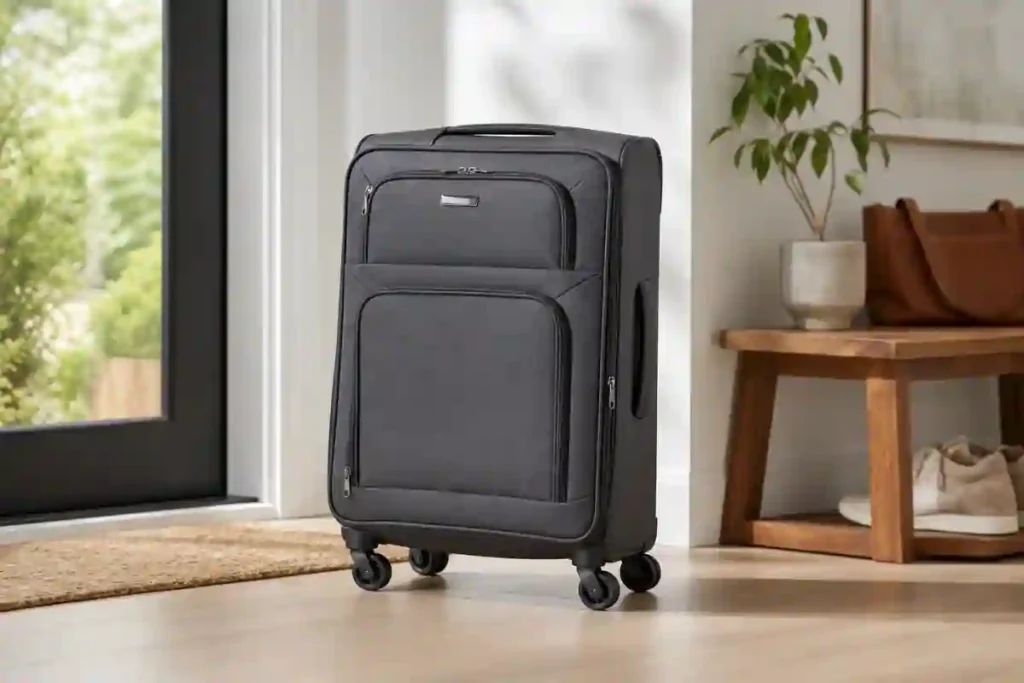
Southwest’s 24×16×10-inch limit is two inches taller and two inches wider than the US standard. The right bag takes full advantage of that extra room.
Target dimensions for Southwest travel
- 23-inch spinner suitcases are the sweet spot: they sit comfortably within Southwest’s 24-inch limit even when packed full. You have a small margin if the bag expands slightly.
- Avoid bags marketed specifically as ’22-inch standard carry-ons’ if you only fly Southwest — you are leaving 2 inches of legal packing room unused.
- Stay under 24 total inches: a bag at exactly the maximum limit, packed to capacity with handles extended, leaves you with zero margin for measurement variation.
Bag types that work best
- Soft-sided 22–23-inch spinner suitcases: the compression flexibility of soft fabric gives you a few extra inches when Southwest’s enforcement is visual rather than mechanical. Travelpro Maxlite 5 in the 21-inch version fits comfortably under the limit.
- Expandable 21–22-inch hard shells: use the expansion zipper on Southwest routes to gain extra depth without exceeding the 24-inch limit. On other airlines that standard is 22×14×9 inches, the expansion often makes the bag non-compliant. On Southwest, the larger limit gives you room to expand legally.
- 40–45L carry-on travel backpacks: Southwest’s bins accept top-loading packs up to 45L without the size anxiety you would face at a Spirit or Frontier gate. The Osprey Farpoint 40 and Tortuga Setout 45L both fit Southwest’s allowance.
See our full guide to the best 24-inch carry-on bags — all verified against Southwest’s 2026 overhead bin dimensions. Also worth reading: our best luggage for budget travelers for the best value options at every price point.
Frequently Asked Questions
Q: What is Southwest Airlines carry-on size in 2026?
Southwest allows carry-on bags up to 24×16×10 inches (61×41×25 cm), including wheels, handles, and all external protrusions. This is larger than the 22×14×9-inch standard used by American, Delta, United, JetBlue, and Alaska Airlines. There is no published weight limit — you must be able to lift the bag overhead without assistance.
Q: Is Southwest’s carry-on bag free in 2026?
Yes. Southwest allows one carry-on bag and one personal item at no charge on every fare, including the Basic fare. There are no Basic Economy-style restrictions that remove carry-on access on cheaper tickets. This is unique among major US airlines — American, Delta, United, JetBlue, and Alaska all restrict carry-ons on their cheapest fare classes.
Q: Did Southwest end ‘Bags Fly Free’?
Yes. Southwest ended ‘Bags Fly Free’ on May 28, 2025 for bookings made on or after that date. The first checked bag now costs $45 and the second costs $55 (for bookings on or after April 9, 2026). Free checked bags remain for A-List Preferred members, Choice Extra fare holders, A-List members (one free bag), Rapid Rewards credit cardholders (one free bag), and active-duty military (two free bags).
Q: Does Southwest enforce carry-on size limits?
Southwest enforces less strictly than budget airlines like Spirit and Frontier, which use physical sizer boxes at most gates. Southwest checks bags visually. On flights above 90% occupancy in 2026, gate agents are more actively measuring personal items and pulling visually oversized carry-ons. Gate-checking on Southwest is always free — unlike budget airlines, which charge $79–$99 for non-compliant bags at the gate.
Q: What is Southwest’s personal item size limit?
Southwest’s personal item limit is 16.25×13.5×8 inches (41×34×20 cm). It must fit completely under the seat in front of you. Acceptable personal items include backpacks, purses, laptop bags, totes, camera bags, and small duffels. In 2026, gate agents on full flights are checking that personal items genuinely fit under the seat — not just that they appear small. Gate-checked personal items go in the hold for free but are inaccessible during the flight.
Q: How do Southwest’s new boarding groups work in 2026?
Southwest switched from A/B/C open seating to 8 numbered boarding groups on January 27, 2026. Groups 1–2: Choice Extra fare, Extra Legroom seat holders, A-List Preferred members. Groups 3–5: Choice Preferred fare, A-List members, Rapid Rewards credit cardholders. Groups 6–8: Choice and Basic fare passengers — Basic fare boards last (Group 8). Your group is printed on your boarding pass. EarlyBird Check-In was discontinued. Everyone on the same reservation (up to 9 passengers) boards in the same group.
Q: Can I bring a guitar or musical instrument on Southwest?
Yes. Small instruments that fit in the overhead bin can travel as your carry-on. Instruments that fit under the seat count as your personal item. If neither works, Southwest allows you to purchase an extra seat for the instrument. Southwest generally waives the oversize fee for instruments checked as luggage, provided the weight stays under 50 lbs. Board in Groups 1–3 to secure bin space.
Q: What happens if Southwest gate-checks my carry-on?
If Southwest gate-checks your carry-on due to full overhead bins, it is always free — there is no fee for a compliant carry-on that gets checked at the gate due to space. Your bag is checked through to your destination and available at baggage claim. You lose access to it during the flight. This is why packing flight essentials in your personal item (under-seat bag) matters — the personal item never gets gate-checked.