If you’ve flown recently, you’ve probably felt the shift. Airlines are getting much stricter about carry-on luggage. Bins fill up faster, boarding takes longer, and rules that used to be ‘flexible’ are now enforced with zero wiggle room. The result? More gate checks and surprise fees.
After navigating hundreds of flights, I’ve refined a system to stay ahead of the curve. This post shares 5 proven tips to keep your bag on the plane every time—whether you’re flying in Europe, Asia, or beyond—so you can stop guessing and travel with total confidence.
Quick Summary: The “Fit Score” Rule
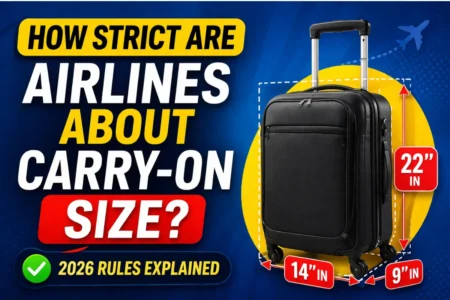
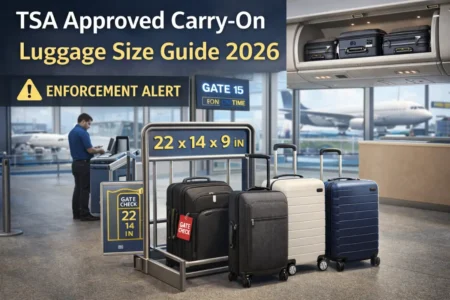
Don’t trust the “Carry-On” label on your luggage. Most US airlines allow 22 x 14 x 9 inches, but international and budget carriers often have smaller limits and strict weight caps of 7–10 kg.
Why Airlines Are Cracking Down on Carry-On Bags
Carry-on only travel used to feel like a cheat code. You could skip baggage claim, avoid checked bag fees, and get out of the airport faster. Now that so many travelers do it, airlines have a different problem: there’s only so much overhead bin space.
When bins fill up, everything slows down. People hunt for space, shuffle bags around, and block the aisle.
Airlines want planes to push back on time, so they’ve started enforcing the rules they used to ignore.
Here’s what that looks like in real life:
- Overhead bin space runs out early, sometimes before your boarding group is halfway through.
- Boarding takes longer because passengers are fighting for space.
- Gate-check announcements have become common, even on flights that feel “normal.”
And the tricky part is that a bag can look fine in the terminal, then suddenly become a problem when the gate area is crowded, and the airline starts measuring or tagging bags.
Airlines that once let bags slide are now charging fees, and the gate is where many travelers get hit.
The good news is you can reduce the odds of getting stopped. It starts with understanding your airline’s size rules, then backing that up with smart packing and a few airport habits that make a difference.
There Is No Universal Carry-On Size (Despite What You’ve Heard)
Many people believe carry-on sizes are now universal. You’ll hear things like, “If it fits Delta, it’ll fit Lufthansa.” That idea has spread thanks to bad reporting and low-effort videos, but it’s not true.
Yes, many US airlines have landed in a similar place in terms of size. But once you fly outside the US, things change fast.
International carriers often allow smaller bags, and many also set strict weight limits. And they don’t just post the rules; many of them actually enforce them.
Here’s a simple way to think about it:
| Airline type/region | Typical carry-on size | Weight limit |
|---|---|---|
| Many US carriers | 22 in x 14 in x 9 in (56 x 36 x 23 cm) | Often no published carry-on weight limit |
| Many European and Asian carriers | Often slightly smaller than common US limits | Often 7 to 10 kg (15 to 22 lb) |
| Many budget carriers | May only include a personal item by default | Charges often apply for anything larger |
Many non-US airlines charge for checked bags, and those 7 to 10 kg limits can sneak up on you. A bag can be the right size and still fail because it’s too heavy.
This leads to the first and most important tip.
Tip 1: Know your airline’s rules, then pick a bag that actually fits
The simplest way to avoid carry-on fees is to know your airline’s rules and bring a bag that meets them.
My take is practical: why buy a bag that works only with one airline when you can buy one that works with most of them? The problem is that many luggage brands sell bags labeled “carry-on” that aren’t carry-on-sized for many airlines, especially outside the US. That label doesn’t protect you at the gate.
So instead of guessing, measure your bag and check it against real airline policies before you travel. That’s where the tool below comes in.
How to measure your carry-on the right way (so you don’t get surprised)
The goal is to measure the bag the same way an airline sizer “sees” it. That means external size, not internal capacity.
- Measure the external dimensions: length, width, and depth.
- Include wheels and handles in the measurement (this is where people get burned).
- If you don’t have a tape measure handy, check the bag’s official product page, but confirm the listed dimensions include wheels and handles.
- In Flight Fit, select whether it’s a suitcase or a backpack. Backpacks have more give, and that squish factor matters.
Once you enter your bag size (in inches or centimeters), run the results, and you’ll see how it stacks up across airlines.
Recommended carry-on and personal item bags mentioned in the video
A few options highlighted for strong fit scores:
- Bellroy Transit Carry-On: Sized to fit nearly 80 percent of airlines worldwide, and has a reasonable weight compared to many hard-sided bags.
- Aer Travel Pack 3: A hard-to-beat choice for a full-size travel backpack.
- Osprey Daylite 26+6: A personal item backpack that can expand when you need a little extra room.
If you’re trying to buy one bag that works across many airlines, the fit score idea is the fastest way to cut through the confusion.
For U.S. travelers, also check USA Carry-On Rules for 2026: TSA Size, Liquids & Battery Rules Explained to avoid surprises at security.
Tip 2 through 4: Keep your carry-on under the weight limit
Size gets the attention, but weight is what catches people off guard on many international flights. A carry-on that weighs too much can get flagged even if it’s the correct dimensions.
These are the best weight-related habits that have worked over hundreds of flights.
Wear your heaviest items
Shoes, jackets, and heavier layers add up fast. If your bag is close to a weight limit, your outfit can save you. Wearing heavier items also frees up space, which helps your bag fit better in a sizer if needed.
Tip 3: Choose lightweight clothing and layer
Heavy clothing can quickly deplete your weight allowance. Lighter pieces that you can layer give you flexibility without packing bulky items. This is especially helpful when you’re dealing with 7-10 kg limits, where every pound counts.
Tip 4: Pack less, and do a test pack before the trip
This is the advice nobody loves hearing, and I say it as someone who used to overpack.
What helped me most was doing a test pack about a week before the trip, then living out of that bag for a few days. I’m not kidding.
Almost every trip, one or two days in, I catch myself thinking, “Why did I bring this?” The test pack is how I stopped packing “just in case” items that never leave the bag.
It also gives you time to fix problems while you’re still at home, not at the gate with a line behind you.
For U.S. travelers, pairing this with NEVER PACK These 13 Outdated Items When You Fly (2026 Guide) can help avoid excess weight and outdated items.
Don’t ignore your personal item; it can save you at the gate.
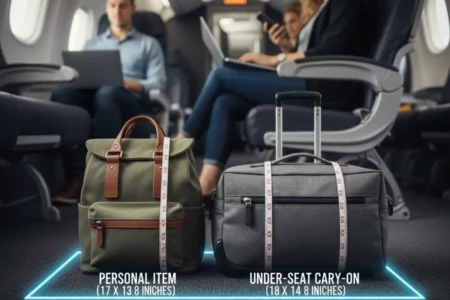
Many airlines allow one carry-on plus one personal item. Personal item sizes is vary, but the basic rule is that it has to fit under the seat in front of you.
Your personal item choice depends on what your main bag is:
- If your main bag is a roller, a backpack, or a sling, a personal item works well.
- If your main bag is a backpack, carrying two backpacks feels awkward, so a sling or tote can be a more comfortable add-on.
If you’re a two-bag traveler, there’s a smart safety move: put expensive items (like electronics) in your personal item. If your carry-on gets gate-checked, you’ll be glad your most valuable gear stays in the cabin.
If you’re looking for the best options that actually fit strict airline limits, check out my guide: 11 Best 18x14x8 Personal Item Bags for 2026
Tip 5: Airport habits that reduce gate-check risk
Once you’ve got the right bag and you’ve packed it well, the last piece is how you move through the airport. A few simple habits can cut down how often your bag gets scrutinized.
Avoid the check-in counter if you can
Check in online. It saves time and reduces the chance someone will size or question your bag before you even reach the gate. The counter is where policies can be enforced early, especially on strict routes.
Board as soon as your group is called
Don’t crowd the lane before your group; nobody likes that. But also don’t hang back once your group is called.
I’ve seen the “everyone needs to gate check” announcement happen mid-boarding group. When they call my group, I’m getting on the plane. Early boarding within your assigned group gives you better odds of finding overhead space.
If an airline tries to charge you, confirm what your ticket includes.
Before you pay, double-check your ticket details. Many transatlantic and trans-Pacific flights include a free checked bag, so you might already have that benefit.
Also, some airline credit cards include a free checked bag. If you paid with an affiliated card (the video mentions a United card example), remind the agent about the benefit.
If you’re active duty military, thank you for your service. Many airlines waive baggage costs for service members, so it’s worth asking before you pay.
These steps won’t win every argument, but they keep you from paying fees you never owed in the first place.
For U.S. travelers, combining these habits with New Carry-On Rules Starting January 1, 2026: Is Your Bag Now Too Big? ensures you stay compliant.
Conclusion: Make your carry-on boring (in the best way)
Airlines are watching carry-ons more closely, but you can still travel without bag fees if you treat it like a system. Know your airline’s rules, check your bag with Flight Fit, manage weight early, and use your personal item wisely.
Add a few airport habits, like checking in online and boarding on time, and you’ll cut down the chances of a gate check.
If you want one next step, start by measuring your bag and getting your fit score before your next trip. It’s a quick check that can save you money and stress at the gate.
FAQ: Carry-On Bags on International Flights
What is the standard carry-on size for international flights?
There is no universal carry-on size for international flights. Many European and Asian airlines allow slightly smaller bags than common US limits and often enforce strict weight limits. Always check your airline’s current baggage policy before traveling.
Do international airlines enforce carry-on weight limits?
Yes. Many airlines in Europe and Asia enforce carry-on weight limits, typically 7–10 kg (15–22 lb). Bags that meet size rules can still be gate-checked if they exceed the weight limit.
Can a carry-on bag be gate-checked even if it fits the size rules?
Yes. Carry-on bags are frequently gate-checked when overhead bins fill up or when airlines enforce weight limits at the gate. This often happens during full flights or on routes using smaller aircraft.
Are backpacks treated differently from rolling carry-on suitcases?
Backpacks can have more flexibility because they compress slightly, but airlines still measure external dimensions and weight. A backpack that appears small can still fail if it exceeds published limits.
What happens if my carry-on is too heavy at the gate?
If your carry-on exceeds the airline’s weight limit, it may be gate-checked with a fee, depending on the fare type and airline policy. Fees are often higher at the gate than when booked in advance.
Do low-cost airlines include a free carry-on bag?
Many low-cost airlines only include a personal item by default. Larger carry-on bags usually require an additional fee or priority boarding purchase. Always check what your ticket includes.
Is a personal item required to fit under the seat?
Yes. A personal item must fit completely under the seat in front of you. Airlines may ask you to place it in a sizer or demonstrate under-seat fit during boarding.
Can airline staff weigh carry-on bags at the gate?
Yes. Gate agents can weigh carry-on bags at any time, especially on international and regional routes. This is common on European and Asian airlines.
How can I reduce the risk of my bag being gate-checked?
Use a bag that fits airline rules, keep weight under limits, check in online, board promptly when your group is called, and avoid overpacking. Wearing heavier items can also help reduce carry-on weight.
Are carry-on rules different on regional or short-haul international flights?
Yes. Regional and short-haul flights often use smaller aircraft with limited overhead space, increasing the likelihood of gate checks—even for correctly sized bags.
Airline baggage rules changed again in 2026. Our detailed US Domestic Airlines Carry-On Rules guide covering airline baggage policies, carry-on size limits, personal item dimensions, overhead bin rules, and hidden carry-on fees for Delta, United, American, Southwest, Spirit, Frontier, and more.