The Traveler’s Nightmare: You bought the “right” size bag, but now you’re at the gate, staring down the rigid metal sizer. Will it fit, or will you pay a last-minute fee?
The painful truth is, published airline dimensions are often misleading. The only thing that guarantees a stress-free boarding experience is the real-world fit in the sizer box which is more important than ever as travel security tightens (for a look at upcoming screening and ID changes, see our guide on the USA Travel Rules Changes in 2026: TSA’s New Rules Every Traveler Must Know).
We solved this problem for good. This is the definitive guide to the Best Carry-On Bags That Fit Airline Sizers. Our team conducted extensive, independent testing—physically dropping eight top-rated bags into 29 different sizer bins covering the rules of 39 airlines, from strict budget carriers to global legacy giants.
Stop gambling with your travel budget. Start traveling with complete confidence.
100% Unbiased, Data-Driven Testing: Every piece of luggage was purchased and tested on genuine trips. We provide real data, not manufacturers’ marketing claims.
Why Carry-On Luggage Size is The Biggest Scam in Travel
To beat the system, you must understand the rules of the game. Here is why travelers face so much gate anxiety:
1. The Full Measurement Rule
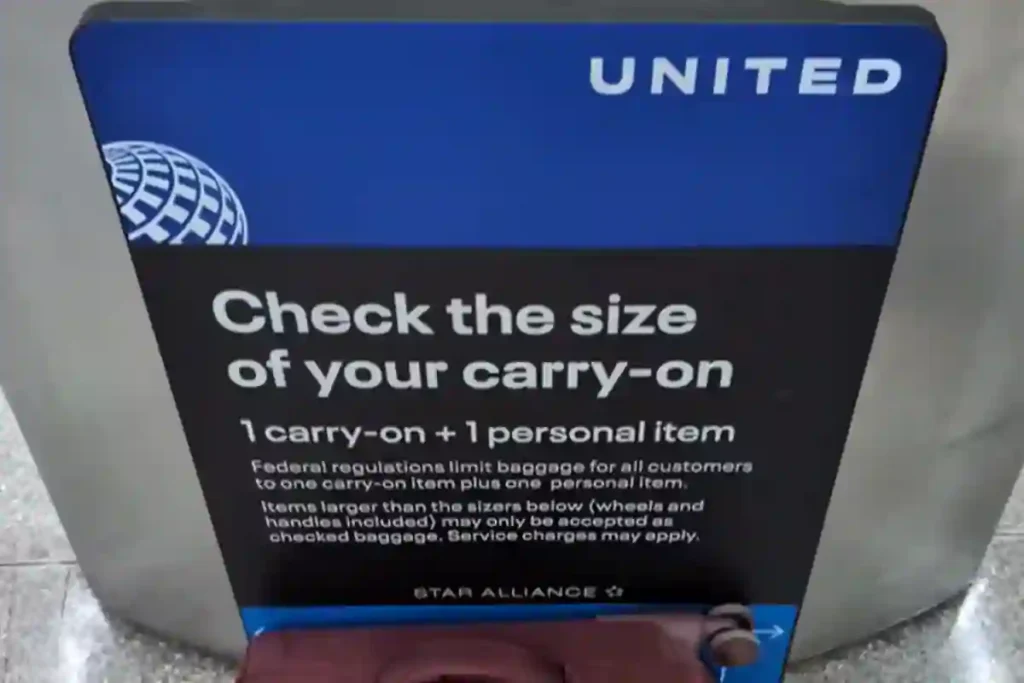
Manufacturers often list the case size, omitting the crucial parts that hit the sizer first: the wheels, top handle, and side feet.
CLARIFICATION: All fit results and dimensions in this guide are based on the full, external measurement of the bag, including all wheels, feet, and handles. This is the only size the airline sizer measures.
2. Rigidity vs. The Flex Factor
Some bags slightly exceed the official dimensions but still pass the test because they possess the Flex Factor.
A soft-sided bag or a hard-shell with slightly flexible corners can compress just enough. A perfectly square, rigid shell offers zero forgiveness.
We highlight which models have this critical advantage.
3. The Unspoken Weight Trap (The Budget Traveler’s Lifeline)
On the world’s strictest carriers (especially those with 7kg/15lb limits), weight is your final enemy. To maximize your packing allowance, you need a bag with the lowest possible empty weight.
The 8 Top-Rated Carry-On Luggage Tested
We selected a mix of the most popular hard-shell and soft-sided options to test against the toughest airline sizers.
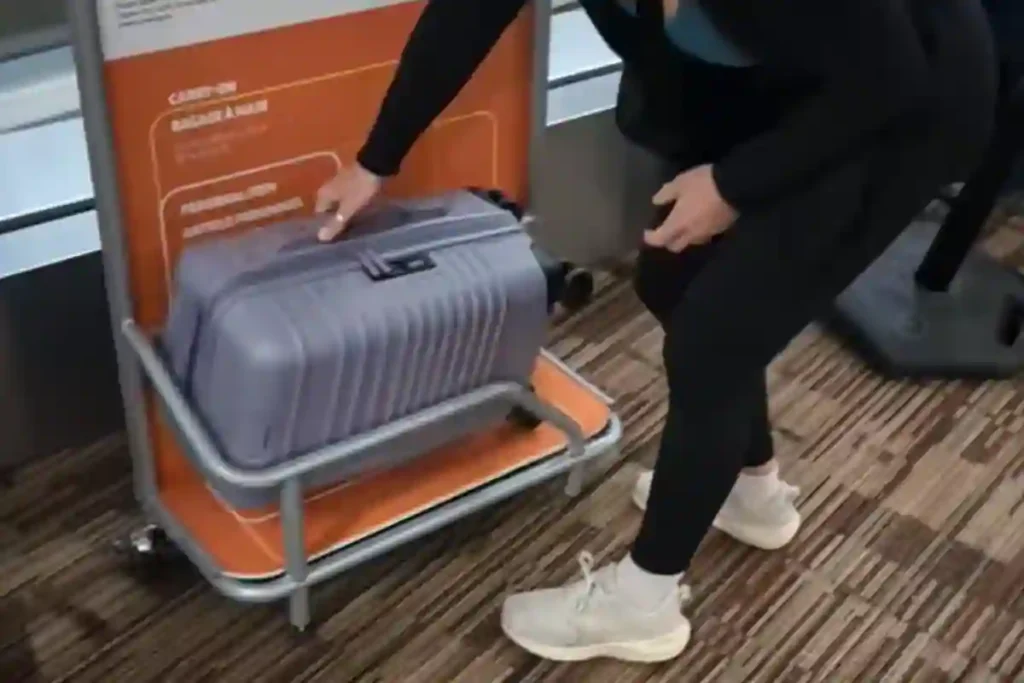
| Bag Name | Type | Key Feature & Empty Weight |
| Lipault Plume Cabin Spinner Samsonite | Soft-shell Spinner | Maximum Flexibility; Ultra-Light (4.8 lbs / 2.18 kg) |
| Travelpro Maxlite® 5 19″ Intl | Soft-shell Spinner | International Size Focus; Flight-Crew Approved. (5.3 lbs / 2.4 kg) |
| Monos Carry-On | Hard-shell Spinner | Excellent Style & Durability; Great All-Around Fit. |
| Antler Hard Shell Cabin | Hard-shell Spinner | Precise Shape; Reliable Fit, Minimal Flex. |
| Bric’s X-Spinner | Soft-sided Spinner | Premium Build; High Material Flex Advantage. |
| Flipside Carry-On | Hard-shell Roller | Smart Internal Layout. |
| Beis Small Carry-On Roller | Hard-shell Carry-on | Popular Stylish Option. |
| Travelpro Maxlite® 5 20″ Intl | Soft-shell 2-Wheeler | Classic Two-Wheel Roller. |
Real-World Results: Your Gate-Check Proof Carry-On Guarantee
We grouped the sizers by their actual size to create a simple cheat sheet. Pick a bag that fits your strictest group, and you’re compliant everywhere else.
Group 1: The Strictest International Benchmark (55 x 35 x 25 cm)
This is one of the smallest and tightest size groups. It shows up on several international airline sites.
Sizer dimensions: 55 x 35 x 25 cm Tested airlines with real bins: Air France, KLM, Singapore Airlines Other airlines using the same measurements include Avianca, Copa, and LATAM.
Bags that fit this group cleanly:
- Lipault by Samsonite Leo Plume cabin spinner
- Antler Hard Shell
- Monos Carry-On
- Bric’s X-Spinner
- Flipside Carry-On
If your cabin baggage rules match 55 x 35 x 25 cm, these bags that actually fit airline rules in this group are a safe pick.
If the same carry on bag or cabin bag works for Air France or Singapore, it will also suit other budget international or full-service carriers using the same numbers.
Any carry-ons that work here also handle every larger group that comes later.
Group 2: 55 x 40 x 20 cm – popular with low-cost European airlines
This group is narrow in depth but a little wider, which helps when your packing space is mostly flat.
Sizer dimensions: 55 x 40 x 20 cm Airlines: Condor, and the same frame is common on Ryanair, Icelandair, and others like Vueling that operate as a Low-cost carrier in Europe.
Bags that worked in this group:
- Travelpro Maxlite 5 19″ International
- Travelpro Maxlite 5 20″ International
- Antler Hard Shell (tested directly in a Ryanair bin)
- Monos Carry-On
- Bric’s X-Spinner (even with the front Pocket slightly stuffed)
On stricter budget airline flights, you may want to pull a jacket or shopping bag out of the front Pocket so the suitcase slides in easier. Once the bag fits the frame, staff usually wave you through.
Group 3: 55 x 40 x 23 cm – a bit more depth
This group keeps the same height and width but adds 3 cm of depth, which feels like a lot when packing.
Sizer dimensions: 55 x 40 x 23 cm Tested airlines with sizers: Air Canada, Air Transat, Lufthansa, Austrian, Brussels Airlines, Swiss, Turkish Airlines, plus Canadian carriers Porter and Flair.
Other airlines with the same size requirements include Fiji Airways, Finnair, LOT, SAS, AirBaltic, and Wizz Air.
Every bag from the earlier groups fit here, including:
- Flipside Carry-On
- Bric’s X-Spinner
- Monos Carry-On
- Antler Hard Shell
- Both Travelpro Maxlite 5 versions
If you fly a mix of North American and European carriers, this group hits a sweet spot. The bins are still on the strict side, but there is a bit more forgiveness for slightly boxy luggage pieces.
Group 4: 55 x 40 x 25 cm – generous depth
Now you keep the same height and width but gain even more depth.
Sizer dimensions: 55 x 40 x 25 cm Airlines using this size: Allegiant, TAP Air Portugal, Viva Aerobus, Aer Lingus.
Every carry-on already mentioned fits these bins with room to spare. If you mostly fly these carriers and pack smart with items like a slim garment bag or a compact underseat bag, you will rarely be asked about your carry-on size.
Group 5: 56 x 36 x 23 cm – classic US major airline size
This is the size you will see most often on big US carriers.
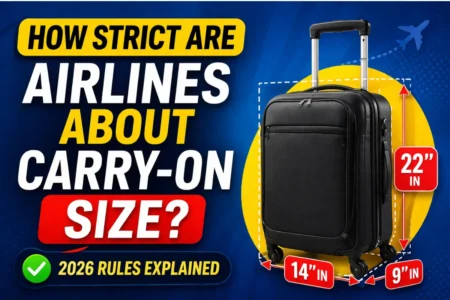
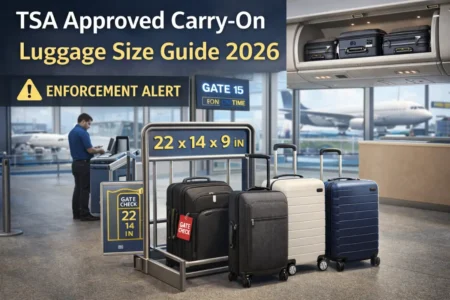
Sizer dimensions: 56 x 36 x 23 cm (about 22 x 14 x 9 inches) Airlines: United, American, JetBlue, Alaska, Hawaiian, Delta, WestJet, plus several other domestic airlines.
By this point, every tested suitcase, trolley, or flight bag dropped into the frame without a fight:
- Monos Carry-On
- Both Travelpro Maxlite 5 models
- Bric’s X-Spinner
- Lipault by Samsonite Leo Plume
- Flipside Carry-On
- Beis Small Carry-On Roller
- Antler Hard Shell and Antler Soft-sided
The bin is large enough that it also works for many popular bags like Away, Quint, July, Tumi, and Briggs & Riley, including some larger carry-on versions of the Monos case. It is a friendly size group if you like a bit more Space without checking a bag.
Group 6: 56 x 45 x 25 cm – very generous cabin bins
If you fly a lot with British or European full service brands, this is what you often see.
Sizer dimensions: 56 x 45 x 25 cm Airlines: British Airways, easyJet, plus a few others.
With a 45 cm width, these sizers are roomy. At the time of filming, the bags in the bin were:
- Lipault by Samsonite Leo Plume
- Antler Hard Shell
- Monos Carry-On
- Beis Small Carry-On Roller
- Bric’s X-Spinner
Because this bag meets the strictest dimension requirements, all other carry-on bags we previously tested also comply.
This universal compliance is what makes traveling with a sizer-safe carry-on truly effortless.
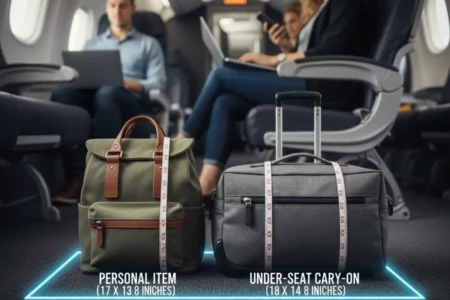
You can also easily bring an additional, compliant personal item—such as a slim travel backpack or a work bag—without concern for agent pushback.
Group 7: 61 x a little over 40 x 25 cm – the biggest cabin sizers
These are the most generous carry-on frames you will see on mainstream carriers.
Sizer dimensions: around 61 x 40+ x 25 cm (about 24 x 16 x 10 inches) Airlines: Southwest, Frontier, Sun Country, with Spirit slightly smaller but similar.
At this level, every single piece of carry-on luggage tested fits with room to spare. If you are used to squeezing into a tiny airline sizer in Europe, these bins feel almost oversized, like they were built for a family 3-piece hard side luggage set.
For many travelers, the main issue here is not size but Weight and weight limit, especially when you pair a big carry-on with a heavy Backpack full of Electronics.
My top carry-on picks that actually fit sizers
After testing carry-on bags that actually fit in 29 different bins, one truth stands out: there is no single carry-on that doesn’t get questioned on every carrier. Size rules and size limitations are simply different brand by brand.
That said, some bags are much safer than others if you want reliable travel without surprises at the gate.
Here are the best carry-on bags that actually worked well across strict and relaxed airlines.
For strict and international airlines
Both are compact, well shaped for tight bins, and easy to handle when you are jumping from a tram to security. They shine on flights where every centimeter counts.
For the best all-around option
These are the best carry-on choices if you fly a mix of US majors, European carriers, and the odd budget airline.
They handle most size limits without drama and still give you good packing space for a weekend getaway or longer trip.
For the best soft-sided options
- Bric’s X-Spinner
- Travelpro Maxlite® 5 20″ International two-wheeler
A soft-sided or semi soft case can flex into tighter frames and offers handy outer pockets for a water bottle or Electronics. These two are great if you like a slightly more forgiving feel than a hard-shell.
In all of these, you will find details like solid spinner wheels, padded handles, and smart interiors with compression straps, tie-down straps, and organizing sections.
For a complete breakdown of global restrictions, consult our comprehensive resource: The Ultimate Hand Luggage Size Chart 2025: Maximize Your Carry-On Allowance. Knowing the exact millimeter you have to work with is the first step in buying smart.
Final tips before you fly with your next carry-on
When you are choosing your next flight bag, think about more than just the number on the tag. Look at how stiff the shell is, whether the corners can flex a little, and where you will put things like a Laptop, cords, and small Electronics.
Ask yourself:
- Do you mostly fly strict european airlines, or larger domestic airlines in the United States?
- Will this bag travel alone, or as part of a luggage set along with checked luggage?
- How often do you need a true personal item or personal bag instead of a larger roller?
A well-chosen travel backpack, slim garment bag, or compact underseat bag is your key to avoiding checked baggage fees on short trips.
Pair one of these personal items with the right roller, and that suitcase can serve for years as your main travel companion, handling everything from quick hops to long-haul weekend getaways.
The final strategy is simple: Match your luggage to the strictest size requirements you face most often.
Follow that rule, pick from these tested bags that actually fit the bins, and you will spend far less time arguing with a metal box and far more time enjoying reliable travel.
You have the data. Now, travel with total confidence knowing your carry-on luggage is officially gate-check proof.