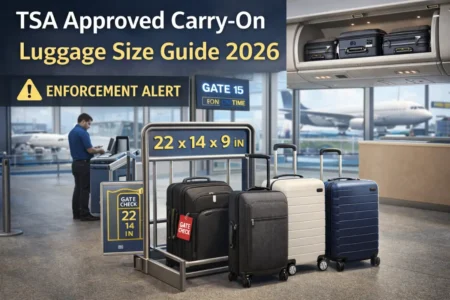
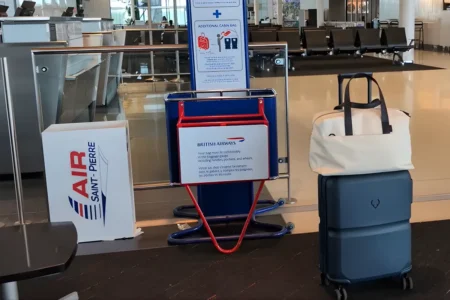
You’re standing at the gate, bag in hand, and you spot it — the metal sizer box propped up next to the agent’s desk. Your stomach drops a little. Did you actually check the wheels when you measured your bag at home, or did you just eyeball it?
If that’s happened to you, you’re in good company. It’s one of the most common travel worries out there, and the honest answer is messier than most articles make it sound: the size limits themselves are clearly published, but whether anyone actually enforces them depends on the airline, the flight, the agent working that day, and how full the plane is.
This guide is built from reviewing the current baggage policies published directly by Delta, United, American, Frontier, and the TSA, cross-checked against how those rules actually play out at the gate based on recent traveler reports and airline announcements from the past year — including two genuinely big changes most guides haven’t caught up with yet.
This guide is for you if you’re:
- A US domestic traveler trying to avoid a surprise fee
- Flying carry-on only and cutting it close on size
- A first-time flyer who’s never dealt with a gate agent over a bag
- Someone comparing a budget carrier against a full-service airline for the same trip
The Short Version
If you’re in a hurry: it depends heavily on which airline you booked.
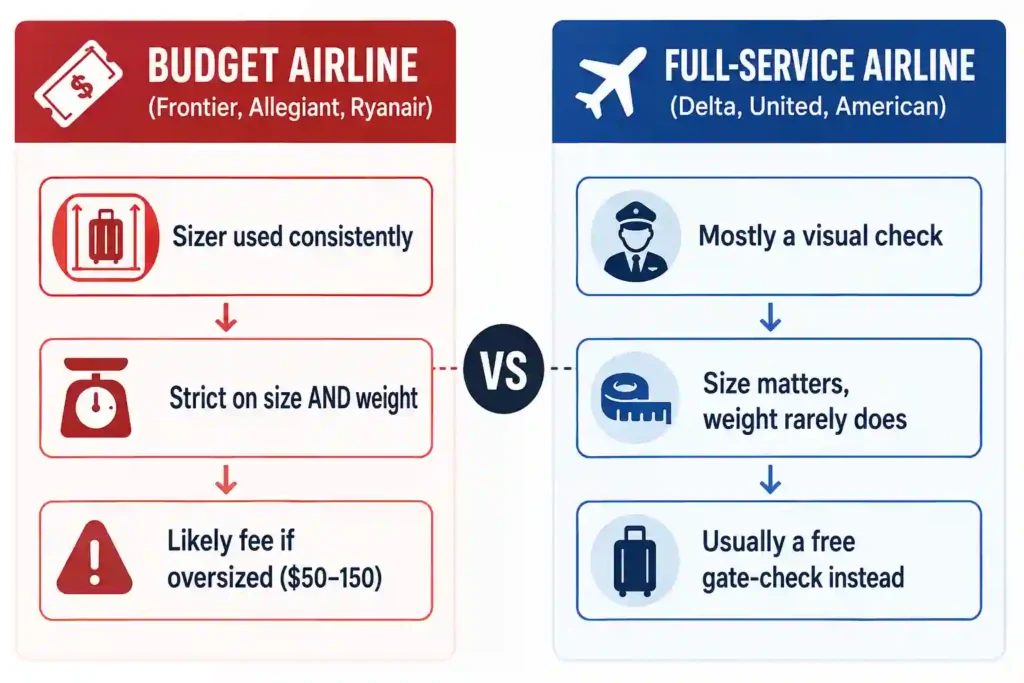
Budget carriers like Frontier and Allegiant, along with European names like Ryanair and EasyJet, are genuinely strict. Their whole pricing model depends on charging for extras, and carry-ons are one of the biggest ones. Expect real enforcement and real fees — often $50 to $150 if your bag gets flagged at the gate.
Full-service airlines like Delta, American, and United are a different story, and getting more relaxed by the look of it. Enforcement exists, but it’s inconsistent, and two of the three don’t even use a physical sizer at the gate anymore. More on that in a second.
A lot of the time, what actually happens isn’t a fee at all — it’s a free gate-check because the overhead bins simply ran out of room. That’s the single most common outcome across every airline, budget or not.
One more thing worth clearing up before we go further: older versions of this kind of guide usually hold up Spirit Airlines as the go-to example of a strict budget carrier.
That’s no longer accurate — Spirit shut down completely on May 2, 2026, after it couldn’t secure a federal bailout amid rising fuel costs. If you’re comparing budget airlines today, Frontier and Allegiant are the ones worth knowing.
What’s Actually Changed in 2026
2026 Key Changes at a Glance
- Spirit Airlines ceased operations entirely (May 2, 2026)
- American Airlines removed gate bag sizers (October 2025)
- Southwest ended free checked bags for most fares (2025)
- TSA still doesn’t set carry-on size limits — that’s always been an airline-by-airline call
A few things worth updating your mental model on:
- American Airlines removed the metal sizer boxes from its gates in October 2025. The size limit itself hasn’t changed — it’s still 22 x 14 x 9 inches — but gate agents now make the call by eye instead of forcing a physical test, and the sizers themselves moved back to the check-in lobby. United, for what it’s worth, actually did this same thing years earlier, back in January 2020 — it’s Delta that’s the one still running gate sizers as standard practice.
- Spirit Airlines ceased operations entirely on May 2, 2026.
- Southwest ended its long-running free checked bag policy for most fares back in 2025 — worth knowing since Southwest’s carry-on allowance is still generous, but its checked-bag policy no longer is.
None of this changes the actual size limits. It changes how often you’ll be asked to prove your bag fits one.
What Size Is a “Standard” Carry-On, Anyway?
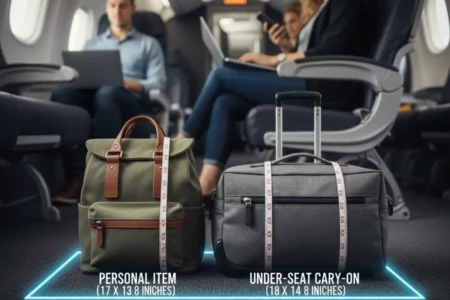
Delta, American, United, Alaska, and JetBlue all cap carry-ons at 22 x 14 x 9 inches, wheels and handles included.¹ That works out to roughly 45 linear inches.
Two airlines give you more room: Southwest and Frontier both allow 24 x 16 x 10 inches. On Frontier, that extra space doesn’t come free — carry-ons are a paid add-on there, separate from the free personal item.²
Worth knowing: the TSA doesn’t actually set carry-on size limits. TSA controls what’s inside your bag — liquids, batteries, sharp objects — not how big the bag itself can be. That’s an airline-by-airline call, not a federal one, and it trips a lot of people up.
Want the exact numbers for a specific airline? Our carry-on suitcase sizes by airline guide breaks down every major US carrier side by side.
Confirmed on each airline’s official baggage page — see Sources at the bottom of this article. ² Confirmed on Frontier’s official bag size page — see Sources.
The part that trips people up isn’t the size limit — it’s how they measure their own bag. A suitcase advertised as “22 inches” is usually measured by the shell alone.
Add the wheels and the telescoping handle housing, and you can easily be looking at 23.5 inches once it’s packed and standing upright. Measure the bag the way it’ll actually look rolling up to the gate, not the way it’s listed on the product page.
Weight barely matters on the full-service airlines — nobody’s putting your Delta carry-on on a scale. Budget carriers are the exception. Frontier enforces a 35-pound carry-on weight limit, and they will actually check it.
When Do Airlines Actually Check Your Bag?
At the gate, and it’s changed recently on one airline. On Delta, this is still where most enforcement happens, sizer box and all.
American removed its gate sizers in October 2025, and United actually did the same years earlier, in 2020 — on both, agents work off a visual judgment call instead of a physical box, which in practice means more borderline bags get through than they used to. Budget carriers haven’t made this change; their sizers are still front and center.
Boarding itself is where people get caught off guard. You’ve cleared the gate, you’re walking down the jetway, and a flight attendant stops you because the bins filled up faster than expected. This happens more on crowded flights, and it’s part of why boarding earlier — even just paying for priority boarding when it’s cheap — genuinely helps. By the time agents start pulling bags near the back of the line, you’re already seated with yours stowed.
Check-in almost never involves a size check. The one exception is budget airline agents at busy airports, who’ve occasionally been known to flag oversized bags before travelers even reach security, though it’s not something they do consistently.
Is Your Bag Actually at Risk? A Quick Way to Check
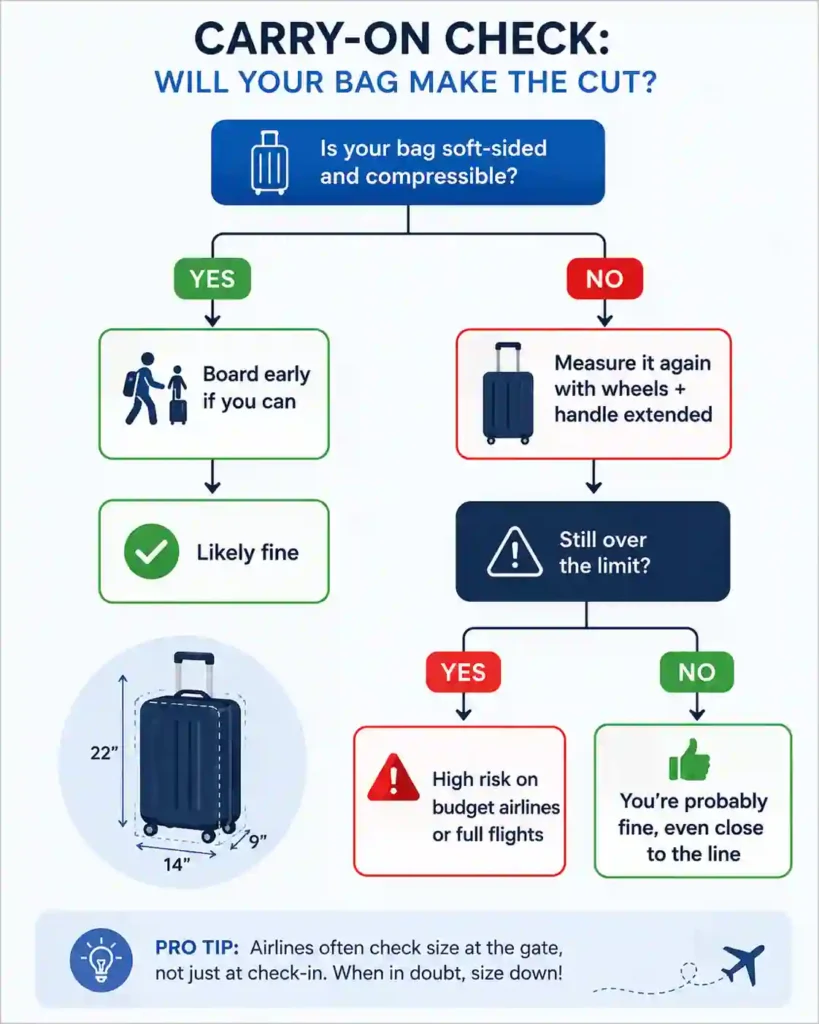
So What Happens If Your Bag Gets Flagged?
On a budget carrier, you’re probably paying a fee on the spot — usually $50 to $150, tagged and checked into the hold right there. If you have a tight connection, that’s the moment your trip gets more stressful, since you won’t see the bag again until baggage claim.
On a full-service airline, it’s often a non-event. If the bins are full and your bag is a reasonable size, gate agents will frequently just check it for free — this isn’t a punishment, it’s just how they manage limited space on a full flight.
Worth separating this from actual baggage mishandling, which is a different problem: globally, airlines mishandled about 24 million bags in 2025, down 23% from the year before, according to SITA’s 2026 Baggage IT Insights Report. A bag checked at the gate because the bins are full isn’t part of that number — it’s routine, not an error.
Where this actually costs you money is on budget carriers, and specifically if you didn’t plan ahead. Frontier and similar airlines charge noticeably more for a carry-on paid at the gate than one added during booking, often close to double. If you’re flying one of these airlines, add your bag when you buy the ticket. Our post on how to avoid baggage fees on every airline goes deeper on exactly where the savings are.
What If You’re Only an Inch Over?
Probably fine, but not guaranteed.
You’re more likely to get away with it if your bag is soft-sided, the flight has empty seats, you’re flying a major airline (especially American or United, post-sizer-removal), and you’re boarding early.
You’re more likely to get stopped if you’re on Frontier, Allegiant, Ryanair, or EasyJet, the flight is sold out, your bag is a rigid hard-shell that clearly won’t compress, or you’re in one of the last boarding groups.
Why Budget Airlines Are Actually Stricter
It’s not an accident — it’s the business model. Airlines like Frontier and Allegiant keep base fares low by unbundling almost everything, and carry-ons are one of the biggest line items they charge for separately.
Gate agents are trained specifically to spot oversized bags, and sizer boxes get used routinely, not just when something looks obviously wrong.
Full-service airlines make their money differently, mostly on loyalty and repeat business, so nickel-and-diming a frequent flyer over one extra inch is a bad trade for them.
That doesn’t mean you’re safe with an oversized bag on Delta or United, especially on a full flight — it just means enforcement is more situational than systematic, and now, on two of the three, less visible than it used to be.
Carry-On Rules by Airline (2026)
| Airline | Max Size | Weight Limit | How Strict | Fee if Oversized |
|---|---|---|---|---|
| Delta | 22 x 14 x 9 in | Not specified | Moderate, gate sizer still in use | Usually free gate-check |
| United | 22 x 14 x 9 in | Not specified | Moderate, gate sizer removed since 2020 | Depends on flight load |
| American | 22 x 14 x 9 in | Not specified | Moderate, gate sizer removed 2025 | Checked-bag fee may apply |
| Alaska | 22 x 14 x 9 in | Not specified | Lenient | Checked-bag fee may apply |
| JetBlue | 22 x 14 x 9 in | Not specified | Moderate | Checked-bag fee may apply |
| Southwest | 24 x 16 x 10 in | Not specified | Lenient | Usually free gate-check |
| Frontier | 24 x 16 x 10 in | 35 lbs | Strict | ~$99+ at the gate |
| Allegiant | 22 x 14 x 9 in | 40 lbs | Strict | Fee varies by route |
| Ryanair (EU) | ~21.5 x 14 x 8 in | 10 kg (~22 lbs) | Very strict | €25–60+ at the gate |
Fees change often, so treat this as a general guide, not gospel — check the airline’s own page before flying. For a deeper look at one of the harder airlines to predict, see our American Airlines carry-on size breakdown.
How to Actually Avoid Paying a Carry-On Fee
Buy a bag in the 21–22 inch range, not a “medium” 24-incher marketed as carry-on friendly — it usually isn’t, at least not on the major airlines.
Don’t pack it until it bulges. A stuffed bag draws more attention at the gate than a neatly packed one of the exact same dimensions, and it won’t compress into a bin easily either.
If your bag is borderline on size, go soft-sided instead of hard-shell. Fabric gives a little under pressure; a rigid case doesn’t.
Check the specific airline’s rules before you pack, especially on connecting flights — your connecting carrier may enforce something different than your first leg. If you’re heading overseas afterward, check our TSA and international carry-on rules guide too, since European budget carriers run smaller and stricter than anything domestic.
Board as early as your ticket lets you. Bin space disappears group by group, and being early is the easiest way to avoid the whole conversation.
And if you’re flying a budget airline, pay for your bag when you book. It’s meaningfully cheaper than paying at the gate.
For a rundown of specific suitcases that consistently pass sizer checks, see the carry-ons that fit every airline sizer.
Carry-On vs. Checking a Bag
| Carry-On | Checked Bag | |
|---|---|---|
| Size limit | Strict (22 x 14 x 9 in typical) | Flexible (up to 62 linear in) |
| Typical cost | Free if it fits | $30–$60+ on most airlines |
| Weight checked | Rarely, outside budget carriers | Almost always, usually 50 lbs |
| Baggage claim wait | None | Yes |
| Risk of loss or damage | Very low | Low, but real — global mishandling rates dropped 23% in 2025 but still affected 24 million bags (SITA, 2026) |
| Best for | Trips under a week | Longer trips, or traveling with kids |
The Mistakes People Make Over and Over
Forgetting the wheels and handle when measuring. This alone accounts for most of the “but it’s supposed to fit” surprises at the gate.
Packing until the zipper barely closes. An overstuffed bag doesn’t slide into a sizer the same way an empty one would, and gate agents notice.
Assuming every airline plays by the same rules. Flying Delta all the time doesn’t tell you anything about what Frontier or Ryanair will let through — or, now, about what Delta’s sizer-using gate agents will do versus American’s more relaxed ones.
Not checking international rules. European and Asian budget carriers are often stricter than anything domestic, and many of them weigh bags as a matter of routine. A bag that’s fine on United isn’t automatically fine on Ryanair.
Questions People Actually Ask
Do airlines always check carry-on size?
No. Delta still uses gate sizers routinely. American moved theirs to the check-in lobby in October 2025, and United did the same years earlier, in 2020 — both now rely more on agent judgment at the gate. Budget carriers are the most consistent about physically checking bags.
Can I get away with a slightly oversized bag?
Sometimes, depending on the airline, the flight, and your boarding group. A full holiday flight on a budget carrier is a very different bet than a half-empty Tuesday flight on American, where there’s no longer a metal box waiting for you at the gate.
What’s the safest carry-on size?
Around 21 inches for the bag itself, which usually works out to about 22 inches once you account for wheels. That clears nearly every US airline, including the stricter budget ones.
What happens if my bag doesn’t fit the overhead bin?
A flight attendant gate-checks it. On most full-service airlines, that’s free, and you pick it up at baggage claim. Budget carriers may charge you. If you’re connecting, build in extra time for the bag to catch up with you.
Are the rules the same everywhere in the world?
Not close. European budget carriers in particular run smaller and stricter than US airlines, and they weigh bags more often. Don’t assume a bag that’s fine domestically will pass abroad.
Bottom Line
The pattern is more predictable than it feels in the moment. Risk concentrates on budget airlines and on full flights where bin space is already tight. On a roomy flight with a major carrier — especially American or United now that the gate sizer is gone — a slightly oversized bag usually slides through without comment, though that’s a pattern, not a guarantee.
The simplest way to skip the gamble entirely: buy a bag that actually fits, pack it so it doesn’t bulge, and board as early as you’re allowed to.
Related reading on TravelBagInsider:
- Best carry-on suitcases that fit every airline sizer
- How to avoid baggage fees on every US airline
- TSA carry-on rules: size, liquids, and battery limits
- American Airlines carry-on size rules explained
Sources
- TSA — Carry-On Bag Size Restrictions FAQ
- US DOT — Air Travel Consumer Reports
- SITA — 2026 Baggage IT Insights Report
Always confirm current size and weight limits directly on the airline’s own baggage page before flying — policies and fees change without much notice.
Affiliate disclosure: some links on this page may earn us a small commission at no extra cost to you.