

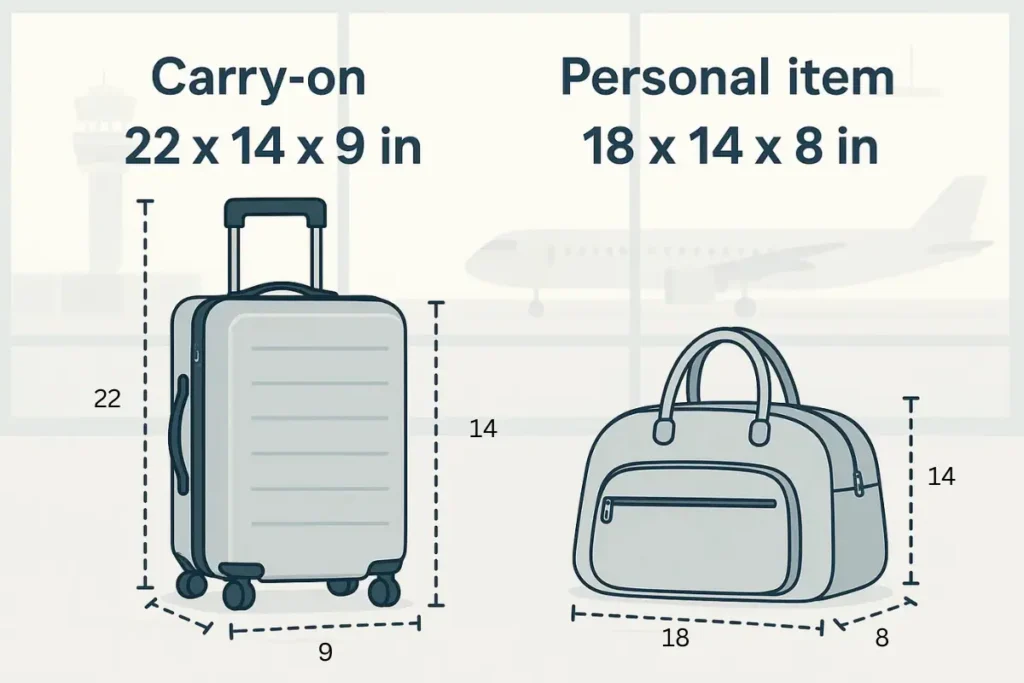
Quick Answer: American Airlines’ carry-on size limit is 22 × 14 × 9 inches (56 × 36 × 23 cm), including wheels and handles.
- Carry-on: 22 × 14 × 9 in (56 × 36 × 23 cm) — free on every fare class, including Basic Economy
- Personal item: 18 × 14 × 8 in (45 × 35 × 20 cm) — also free on every fare
- Weight guideline: 40 lbs (18 kg) — rarely enforced on domestic flights, more consistent internationally
Source: American Airlines’ official carry-on policy
American Airlines Carry-On Policy at a Glance
| Bag Type | Max Dimensions | Max Weight | Stored | Cost |
|---|---|---|---|---|
| Carry-on bag | 22 × 14 × 9 in (56 × 36 × 23 cm) | 40 lbs (18 kg) | Overhead bin | Free |
| Personal item | 18 × 14 × 8 in (45 × 35 × 20 cm) | No official limit | Under-seat | Free |
| Soft-sided garment bag | 51 linear inches max | No official limit | Overhead bin | Free |
Every passenger — regardless of fare class, route, or ticket price — is entitled to one carry-on bag and one personal item at no charge. That includes Basic Economy. That said, entitled to bring and guaranteed overhead bin space are two very different things. The rest of this guide explains exactly where that gap lives and how to close it.
Source: American Airlines official carry-on policy
Official Carry-On Dimensions: 22 × 14 × 9 Inches Explained
American Airlines’ maximum carry-on dimensions are 22 × 14 × 9 inches — that is length by width by depth, and critically, those measurements must include every part of the bag at its largest point.
What “Including Handles and Wheels” Actually Means
This is where most travelers get caught off guard. A spinner suitcase marketed as “22 inches” is almost never actually 22 inches when you extend the telescoping handle and account for the wheel housing at the base.
The real-world measurement of a “22-inch” bag with wheels extended typically runs 23.5 to 24.5 inches. That is over the limit.
Here is what to measure:
- Height: From the bottom of the wheels to the very top of the extended handle
- Width: Across the widest point of the bag, including any exterior pockets, side handles, or straps
- Depth: Front to back at the deepest point — including any bulging pockets when the bag is packed
If your bag passes all three of those measurements at or under 22 × 14 × 9, you are compliant. If it exceeds even one dimension, you are rolling the dice at the gate.
How to Measure Your Carry-On Correctly at Home
- Pack the bag as you intend to travel — not empty
- Place the packed bag upright on a flat floor
- Extend the telescoping handle to its full height
- Measure height from floor (under the wheels) to the top of the extended handle
- Measure width at the widest horizontal point, pockets included
- Measure depth front-to-back at the deepest point, including any front pocket bulge
- If any dimension exceeds the limit, repack until all three are within range
The most common failure point is depth. Most bags are fine at 22 inches tall and 14 inches wide. It is the 9-inch depth that catches people — specifically when the front pocket is overfilled.
Dimensions in Centimeters
For international travelers accustomed to metric measurements:
| Imperial | Metric |
|---|---|
| 22 × 14 × 9 inches (carry-on) | 56 × 36 × 23 cm |
| 18 × 14 × 8 inches (personal item) | 45 × 35 × 20 cm |
American Airlines’ limit aligns with the standard used by Delta, United, Alaska, JetBlue, and several major international carriers — making a 56 × 36 × 23 cm bag one of the most universally compatible carry-on sizes you can buy. See our Airline Hand Luggage Size Chart for a full cross-carrier comparison.
What Is 22 × 14 × 9 in Liters?
A bag at the exact 22 × 14 × 9-inch limit has a theoretical volume of roughly 40 liters. In practice, most compliant rolling carry-ons hold 35–40 liters of usable space once you account for the bag’s structure, frame, and wheels. If you are shopping for a carry-on by volume, look for bags in the 35–40L range.
Personal Item Size Limit: 18 × 14 × 8 Inches
Your personal item must fit under the seat in front of you. American Airlines’ published guideline is 18 × 14 × 8 inches (45 × 35 × 20 cm), though the airline does not use a sizer box to enforce this the way budget carriers do.
For a full breakdown of what counts as a personal item versus a carry-on, see our Under-Seat Carry-On vs. Personal Item survival guide.
What Qualifies as a Personal Item?
- Small backpack or daypack
- Laptop bag or briefcase
- Purse or large handbag
- Small soft-sided tote
- Camera bag
What does not qualify: a full-size carry-on roller bag, a duffel large enough to require the overhead bin, or any bag that cannot physically fit under the seat.
The Under-Seat Reality
Under-seat space varies significantly by aircraft type and seat position. Bulkhead seats — the first row in each cabin — typically have no under-seat storage at all, meaning your personal item must go in the overhead bin.
If you have a bulkhead seat, plan accordingly: your personal item becomes a de facto second carry-on competing for bin space.
Aisle seats on narrowbody aircraft (737, A319, A320, A321) have a structural support that reduces under-seat depth on one side.
If your personal item is a rigid laptop bag at exactly 8 inches deep, it may not slide cleanly under the narrowed side. Soft-sided bags handle this more gracefully.
If Your Personal Item Does Not Fit Under the Seat
If a gate agent determines your personal item needs to go in the overhead bin, it counts against your carry-on slot. You cannot have two items in the bin on the grounds that one was “supposed to be” a personal item. Pack a bag that fits under the seat.
Recommended Personal Item Bags That Fit Under the Seat
The personal item must fit under the seat, generally adhering to the 18 x 14 X 8 inch limit. These bags are specifically designed to fit this smaller space:
| Personal Item bags that will fit | IN | CM |
| Taygeer Backpack | 16 x 11 x 7 | 40.6 x 27.9 x 17.8 |
| Purple Viral Bag | 17 x 12 x 6.5 | 43.2 x 30.5 x 16.5 |
| Classic Tote | 16 x 12 x 5.5 | 40.6 x 30.5 x 14 |
| Samsonite Virtuosa Weekender | 12.3 x 18 x 7.5 | 31 x 45 x 19 |
| Kono Travel Duffel Bag (Small 14L) | 13.7 x 7.87x 7.87 | 34.7 x 20 x 20 |
If you prefer to use a backpack, check out the 7 Airline-Approved Carry-On Travel Backpacks for 2025.
Carry-On Weight Limit: 40 lbs (18 kg)
American Airlines publishes a carry-on weight guideline of 40 lbs (18 kg). This is one of the most overlooked policies in domestic US air travel — most travelers have never heard of it because enforcement is nearly nonexistent on domestic routes.
That said, there are two situations where the weight limit matters:
- International flights — Enforcement is more consistent on international departures, particularly from foreign airports operating under local aviation authority oversight
- If your bag is already flagged for size — A gate agent who has pulled your bag for a size check may weigh it simultaneously. If both size and weight are marginal, you are more likely to be checked
The practical rule: keep your carry-on under 40 lbs. A fully packed 22 × 14 × 9 roller bag typically runs 18–28 lbs depending on contents.
You would need to pack extremely dense items — books, camera equipment, full liquids — to approach 40 lbs. If you are packing that heavy, check a bag instead.
Carry-On Rules by Fare Class
This is the section most guides get wrong, or leave dangerously incomplete.
| Fare Class | Carry-On Bag | Personal Item | Free? | Boarding Group | Bin Space Reality |
|---|---|---|---|---|---|
| Basic Economy | ✅ Included | ✅ Included | Yes | Group 8–9 | High gate-check risk on full flights |
| Main Cabin | ✅ Included | ✅ Included | Yes | Group 5–7 | Moderate — bins typically available |
| Main Plus | ✅ Included | ✅ Included | Yes | Group 4–5 | Good |
| Premium Economy | ✅ Included | ✅ Included | Yes | Group 3–4 | Good |
| Business (Flagship) | ✅ Included | ✅ Included | Yes | Group 1–2 | Bin space essentially guaranteed |
| First Class | ✅ Included | ✅ Included | Yes | Group 1 | Bin space essentially guaranteed |
The Basic Economy Reality
American Airlines is currently one of the most generous US carriers for Basic Economy carry-on policy. Unlike United Airlines — which prohibits Basic Economy passengers from bringing a full-size carry-on bag at all — American allows a full 22 × 14 × 9 carry-on on Basic Economy for virtually all domestic routes.
The catch is not the policy. The catch is the boarding group.
Basic Economy passengers board in Group 8 or Group 9 — the last passengers on the plane. On a full flight, overhead bin space is frequently exhausted by the time Group 5 boards. By Group 9, the only bins still open are typically above non-window seats or several rows away from your seat.
The honest advice: If you are flying Basic Economy, book a personal item that serves as your primary bag. Pack everything you cannot lose — medication, electronics, passport, valuables — in your personal item, and accept that your carry-on roller may get gate-checked.
When it does, it goes free — but it goes in the belly of the plane with checked luggage, and you will collect it at baggage claim, not the jet bridge (on mainline aircraft).
AAdvantage Status Changes Everything
AAdvantage elite members board significantly earlier:
| Status | Boarding Group |
|---|---|
| No status | Group 5–9 (by fare) |
| AAdvantage Gold | Group 4 |
| AAdvantage Platinum | Group 3 |
| AAdvantage Platinum Pro | Group 2 |
| AAdvantage Executive Platinum | Group 1 |
| ConciergeKey | Pre-board |
Boarding in Group 1 or 2 means you will almost always find overhead bin space directly above or near your seat. This is one of the tangible, everyday benefits of elite status that gets undervalued in points-and-miles discussions.
Credit Cards That Upgrade Your Boarding Group
Even without elite status, the right credit card can move you to Group 5, which typically boards before bins are full:
- Citi / AAdvantage Platinum Select Mastercard — Group 5 boarding for the cardholder and up to four companions on the same reservation
- Barclays AAdvantage Aviator Red World Elite Mastercard — Same Group 5 perk
Group 5 is the practical threshold. Bins are usually available at Group 5. They are usually gone by Group 7. If you fly American Airlines even a few times per year with a roller carry-on, these cards pay for themselves in stress avoided.
What Changed in October 2025: The Sizer Removal
In October 2025, American Airlines made a notable operational change: it removed the metal bag sizer boxes from boarding gate areas at airports across its network.
This does not mean carry-on size rules changed. The 22 × 14 × 9 limit remains in full effect.
What changed is how compliance is checked at the gate. Previously, a gate agent could physically ask you to place your bag in the metal sizer frame — a definitive pass/fail test. Now, gate agents rely on visual assessment and use sizer boxes that remain available in the airport lobby, before security, rather than at the gate itself.
American Airlines’ stated rationale was to streamline the boarding process and reduce gate delays. Their guidance to agents shifted toward giving passengers the benefit of the doubt on borderline bags, to keep boarding moving.
What This Means Practically
- Soft-sided bags that are marginally over — slightly more likely to pass without challenge than before
- Hard-shell spinners clearly exceeding the limit — still flagged; shape makes oversizing obvious
- Full bins — the gate-check trigger is now more often bin capacity than bag measurement
- Bags that are obviously non-compliant — still checked and subject to standard fees
The sizer removal does not change the compliance calculus. If your bag meets 22 × 14 × 9, you have nothing to worry about regardless of whether a sizer exists.
If your bag exceeds those dimensions, the risk has shifted from “will it fit in the metal box?” to “will the gate agent let it pass visually?” — a roll of the dice that is not worth taking on a $50 gate-check fee. For a full breakdown of all carry-on rule changes taking effect in 2026, see our New Carry-On Rules 2026 guide.
American Eagle Regional Jets: What’s Different
American Eagle — the regional operation that serves smaller markets and short-haul routes under the American Airlines brand — uses a fleet of regional jets with significantly narrower overhead bins than mainline Boeing and Airbus aircraft.
The aircraft involved are primarily:
- Bombardier CRJ-200 and CRJ-700 — overhead bins on the CRJ-200 in particular are extremely narrow; most roller carry-ons will not fit
- Embraer ERJ-145 — similarly restrictive
- Embraer E170/E175 — somewhat more accommodating than the CRJ series, but still tighter than mainline
On these aircraft, most standard carry-on roller bags cannot fit in the overhead bins regardless of whether they meet the 22 × 14 × 9 limit. The bins are simply too narrow.
What Happens to Your Bag
American Airlines handles this via a planeside valet check (also called a jetbridge valet or gate valet):
- You carry your bag to the end of the jet bridge
- A ground crew member tags it and places it in the cargo hold
- The bag is returned to the jet bridge at your destination upon deplaning — not baggage claim
This is free of charge. It is not a penalty. It is an operational reality of flying regional jets.
Critical tip: Before you board a regional jet, remove from your carry-on everything you will need during the flight — medication, laptop, headphones, valuables, travel documents. Once your bag is valet-tagged and loaded, you will not see it again until you deplane.
How to Know If You Are On a Regional Jet
Check your booking confirmation or the American Airlines app. If the operating carrier is listed as “American Eagle,” “operated by SkyWest,” “operated by Mesa Airlines,” or “operated by Envoy Air,” you are on a regional jet. One line in your itinerary. Significant difference in how you should pack.
Gate-Check Policy: Free vs. Paid — Know the Difference
There are two distinct scenarios in which your carry-on gets checked at the gate, and they carry completely different financial consequences.
Scenario 1: Free Gate Check (Bins Are Full)
If the overhead bins fill up before your boarding group boards, American Airlines will ask compliant passengers to gate-check their carry-ons at no charge.
Your bag gets a tag, goes in the cargo hold, and is returned at baggage claim upon arrival on mainline flights — or at the jet bridge on regional aircraft.
This is the most common gate-check scenario. It costs you nothing.
Scenario 2: Paid Gate Check (Bag Is Non-Compliant)
If your carry-on exceeds the 22 × 14 × 9 size limit and a gate agent identifies it as non-compliant, you will be charged the standard checked bag fee. As of May 18, 2026, American Airlines’ updated fee structure is:
| Route | 1st Checked Bag | 2nd Checked Bag |
|---|---|---|
| Domestic / Caribbean / Mexico / Canada | $50 (or $45 if paid online) | $60 (or $55 if paid online) |
| Basic Economy surcharge | +$5 additional | +$5 additional |
For the full breakdown of every AA baggage fee — including oversize, overweight, and international routes — see our American Airlines Baggage Fees 2026 guide.
Source: American Airlines optional service fees, updated May 18, 2026
The “free gate check” applies only when the issue is bin capacity, not bag compliance. If your bag is oversized and gets flagged — even on a half-empty flight — the fee applies.
How Strict Is American Airlines About Carry-On Size in 2026?
Honest answer: inconsistently strict, with enforcement intensity determined primarily by flight load. We cover this in exhaustive detail in our dedicated guide — How Strict Are Airlines About Carry-On Size? — but here is the American Airlines-specific picture:
- Empty or light flights — Gate agents rarely challenge carry-on size. Enforcement is minimal.
- Full domestic flights — Agents scan actively for obviously oversized bags, particularly spinner bags with protruding pockets or bags that riders are visibly forcing into bins.
- Holiday travel and peak periods — Enforcement spikes. During Thanksgiving, Christmas, and spring break, expect agents to be more deliberate about flagging non-compliant bags because bin space is critical.
- International departure gates — Consistent enforcement, particularly at foreign airports where airline staff follow local civil aviation authority protocols.
The post-sizer-removal landscape (as of October 2025) has shifted enforcement toward visual judgment. Agents are looking for obvious signals: a bag that protrudes significantly beyond the 9-inch depth, a spinner that is visibly wider than adjacent compliant bags, or a bag that a passenger is struggling to close. If your bag looks compliant at a glance, it will likely pass.
If it looks borderline, it will depend on the agent, the flight load, and whether you are boarding early enough that the agent has bandwidth to engage.
The safest carry-on strategy has not changed: buy a bag that genuinely fits 22 × 14 × 9 when packed, and board early enough to secure bin space.
The Visual Pass Strategy: How to Board Without a Second Thought
Understanding how gate agents actually assess carry-ons — rather than how the official policy reads — is the difference between stress-free boarding and a $50 surprise.
Gate agents checking carry-ons visually look for two primary red flags:
1. The Depth Bulge The most common failure point. When the front pocket of a carry-on is overfilled, the bag’s depth expands beyond 9 inches. A bag at 11 or 12 inches deep at the pocket is immediately obvious to an experienced agent. The fix: use your front pocket for flat, thin items only — boarding pass, small notebook, slim wallet. Reserve your compression packing for the main compartment.
2. The Width Creep Bags with external compression straps that are not cinched, or bags with side pockets stuffed to capacity, visually expand the width beyond the standard profile. An agent who sees a bag that looks “fat” will give it a second look. Cinch every strap before you get to the gate.
The practical standard: A bag that looks like a standard carry-on will pass. A bag that looks stuffed beyond capacity will get a second look regardless of whether it technically measures under the limit. Pack to the dimensions, not to the capacity.
Boarding order strategy:
- If you are in Group 1–4: Relax. You will find bin space.
- If you are in Group 5–7: Head to the gate early. Standing near the front of your group when it is called makes a meaningful difference.
- If you are in Group 8–9 (Basic Economy): Pack a personal item that contains your flight essentials. Accept the gate-check probability. Do not skip your boarding call — you must be present for the valet tag to be issued.
Best Carry-On Bags That Fit American Airlines’ Size Limit
Every bag below has been selected for genuine compliance with American Airlines’ 22 × 14 × 9 limit when packed — not just when empty. Measurements listed include wheels and handles unless noted. For a deeper review of each bag tested against 39 airline sizers, see our Gate-Check Proof Carry-On Bags guide.
| Bag | Dimensions (in) | Weight | Volume | Best For | Approx. Price |
|---|---|---|---|---|---|
| Away The Carry-On | 21.7 × 13.7 × 9.0 | 7.7 lbs | 39.8L | All-around everyday traveler | Check Price on Amazon |
| TravelPro Platinum Elite 21″ | 22.0 × 14.0 × 9.0 | 7.4 lbs | 42L | Frequent flyers; durability focus | Check Price on Amazon |
| Osprey Farpoint 40L | 21.0 × 14.0 × 9.0 | 2.7 lbs | 40L | Backpack-style; lightweight travel | Check Price Amazon |
| Briggs & Riley Baseline 22″ | 22.0 × 14.0 × 9.0 | 8.0 lbs | 40L | Premium durability; lifetime warranty | Check Price on Amazon |
| Cabin Max Metz 44L | 21.6 × 13.8 × 9.0 | 2.6 lbs | 44L | Budget travelers; soft-side flexibility | Check Price on Amazon |
| Peak Design Travel Backpack 45L | 20.9 × 12.2 × 8.9 | 4.6 lbs | 45L | Photographers; tech-heavy packers | Check Price on Amazon |
Notes:
- The TravelPro Platinum Elite is the industry standard for frequent flyer carry-ons; it fits American Airlines’ sizer with precision because TravelPro engineered it to do so
- The Osprey Farpoint and Peak Design are soft-sided bags — they benefit most from the “visual pass” flexibility and compress when bins are tight
- The Cabin Max Metz is the best budget option for compliance; its 44L capacity in a sub-$75 bag is exceptional value for occasional travelers
- All dimensions above are measured packed and loaded; always verify your specific bag configuration before travel
If you prefer to use a backpack, check out the 7 Airline-Approved Carry-On Travel Backpacks for 2026.
American Airlines vs. Delta vs. United: Carry-On Rules Compared
| Rule | American Airlines | Delta Air Lines | United Airlines | Southwest Airlines |
|---|---|---|---|---|
| Carry-on size limit | 22 × 14 × 9 in | 22 × 14 × 9 in | 22 × 14 × 9 in | 24 × 16 × 10 in |
| Personal item size | 18 × 14 × 8 in | 18 × 14 × 8 in | 17 × 10 × 9 in | ✅ Yes |
| Basic Economy carry-on allowed? | ✅ Yes (domestic) | ✅ Yes (domestic) | ❌ No (personal item only) | ✅ Yes |
| Basic Economy transatlantic carry-on? | ⚠️ Route-dependent | ❌ No (personal item only) | ❌ No | No published limit |
| Carry-on weight limit | 40 lbs (18 kg) | No published limit | No published limit | limit |
| Basic Economy boarding group | Group 8–9 (last) | Last zone | Group 5 (last for BE) | Last zone |
| Gate sizers at boarding gate? | ❌ Removed Oct 2025 | ✅ Present | ✅ Present | ✅ Present |
The key takeaway: On domestic routes, American Airlines is the most carry-on-friendly of the three major legacy carriers for Basic Economy passengers. The trade-off is boarding last, which makes bin space the limiting factor rather than policy.
By comparison, Southwest allows a larger 24×16×10-inch carry-on — see our Southwest carry-on guide for the full breakdown.
United is the most restrictive. If you frequently fly Basic Economy on United, you are policy-restricted to a personal item only. On American, that same fare class gets you a full roller carry-on — you are just boarding with the last group.
For a full side-by-side of every major US carrier’s carry-on rules, see our US Domestic Airlines Carry-On Rules 2026 guide.
If you fly Delta regularly, our Delta Carry-On Size Guide 2026 covers the same depth for that carrier.
International Flights: Does the Size Rule Change?
The carry-on size itself — 22 × 14 × 9 inches — does not change for international flights. What changes is the fare class carry-on entitlement on certain routes.
Transatlantic Flights (USA to Europe)
On American Airlines transatlantic routes, Basic Economy passengers are restricted to a personal item only — no full-size carry-on. This is the most significant carry-on policy difference between domestic and international travel on AA.
If you book a Basic Economy fare on any AA flight between the US and Europe, your carry-on roller cannot board with you. If you bring it to the gate, it will be checked, and the standard checked bag fee applies.
Always verify your specific fare rules at aa.com before packing for any international flight. The booking confirmation will display your exact baggage entitlement.
Codeshare and Partner Flights
If your American Airlines booking involves a segment operated by a one world partner airline — British Airways, Iberia, Qatar Airways, Cathay Pacific, and others — the operating carrier’s carry-on policy governs that segment.
British Airways, for instance, uses a 22 × 18 × 10-inch limit, which is more generous. Qatar Economy allows 50 × 37 × 25 cm. Verify each segment separately.
Latin America and Caribbean
Carry-on policy is consistent with domestic rules (22 × 14 × 9) on most AA-operated Latin American and Caribbean routes. Basic Economy carry-ons are generally permitted, though specific fare rules vary. Always confirm at booking.
Items Exempt from the Carry-On Limit
American Airlines allows certain items on board in addition to your carry-on and personal item, at no charge:
| Item | Policy |
|---|---|
| Diaper bag | One per child traveling; does not count as carry-on or personal item |
| Stroller / child car seat | Gate-checked free; returned at jet bridge |
| Assistive devices | Wheelchairs, canes, walkers, crutches, braces — free, always permitted |
| CPAP / medical devices | Permitted as an additional carry-on item with documentation if needed |
| Soft-sided garment bag | Up to 51 linear inches; counts as carry-on |
| Breast pump | Permitted in addition to personal item |
| Infant car seat | Can be used in-seat if purchased seat for infant; otherwise gate-checked free |
Musical instruments: Small instruments that fit within the 22 × 14 × 9 limit (violins, small guitars in soft cases) can occupy overhead bin space. Larger instruments require a purchased seat or must be checked as special baggage.
Lithium batteries and electronics: Carry-on is actually the required location for most lithium battery devices. Power banks and spare laptop batteries cannot be checked — they must travel in the cabin.
Frequently Asked Questions
What is American Airlines’ carry-on size limit?
American Airlines’ carry-on size limit is 22 × 14 × 9 inches (56 × 36 × 23 cm), including wheels and handles. The personal item limit is 18 × 14 × 8 inches (45 × 35 × 20 cm), and both are free on every fare class, including Basic Economy. The official weight guideline is 40 lbs (18 kg), though it’s rarely enforced on domestic flights. Note: American removed its gate sizer boxes in October 2025 — the size limit hasn’t changed, but agents now judge bags by eye instead of a physical test.
Does the 22 × 14 × 9 measurement include wheels and handles?
Yes. The 22 × 14 × 9-inch limit includes every part of the bag — the wheels at the bottom, the extended telescoping handle at the top, and any exterior pockets at their widest point. Measure your bag packed and with the handle fully extended.
Can Basic Economy passengers bring a carry-on on American Airlines?
Yes, on most domestic US routes. American Airlines includes a full-size carry-on and personal item on Basic Economy for domestic, Caribbean, Mexico, and Central America flights. The restriction is not the policy — it is boarding last in Group 8–9, which makes overhead bin space scarce on full flights. On many transatlantic (US to Europe) routes, Basic Economy is restricted to a personal item only. Verify your specific fare at aa.com.
What happens if my carry-on is too big on American Airlines?
A gate agent will ask you to place it in a sizer (available in the airport lobby area). If it does not fit within 22 × 14 × 9 inches, you will be charged the standard checked bag fee: $50 ($45 if paid online for tickets issued after May 18, 2026). This is separate from the free gate-check that happens when bins are simply full and your bag is compliant.
Did American Airlines remove bag sizers from gates?
Yes. In October 2025, American Airlines removed the metal bag sizer boxes from gate boarding areas. Sizers remain available in airport lobbies for self-service checks. Gate agents now enforce compliance through visual assessment. The size rules themselves (22 × 14 × 9) have not changed.
What is the personal item size limit on American Airlines?
18 × 14 × 8 inches (45 × 35 × 20 cm). Your personal item must fit under the seat in front of you. Standard compliant personal items include small backpacks, laptop bags, purses, and soft-sided totes.
Does American Airlines weigh carry-on bags?
Rarely on domestic flights. American Airlines publishes a 40-lb (18 kg) carry-on weight guideline, but active weighing at the gate is uncommon for domestic routes. Enforcement is more consistent on international departures and at foreign airports.
Is a 22-inch suitcase compliant with American Airlines?
It depends on the specific bag. A suitcase marketed as “22 inches” typically refers to the bag body height, not the full height including wheels and extended handle. Measure the bag fully extended and packed. Many “22-inch” bags run 23.5–24.5 inches total with handles — which exceeds the limit. Confirm actual dimensions before purchasing or packing.
What is 22 × 14 × 9 inches in Centimetres?
22 × 14 × 9 inches equals 56 × 36 × 23 centimetres.
How do I avoid having my carry-on gate-checked?
Pack within the 22 × 14 × 9 limit. Board in the earliest group available to you. If you are flying Basic Economy, consider using your personal item as your primary bag and treat the carry-on as optional. The AAdvantage credit cards (Citi and Barclays) grant Group 5 boarding, which typically ensures bin access on most domestic flights.
Can I bring both a carry-on bag and a personal item on American Airlines?
Yes. Every passenger is entitled to one carry-on (overhead bin) and one personal item (under-seat) on every fare class. The personal item must genuinely fit under the seat — it cannot be placed in the overhead bin as a second carry-on.
What is a valet check on American Airlines?
A planeside valet check (also called a jet bridge check) is a free service used on American Eagle regional jets where overhead bins are too small for standard carry-on rollers. You surrender your bag at the end of the jet bridge before boarding. It is loaded in the cargo hold and returned to the jet bridge at your arrival airport upon deplaning — not at baggage claim.
Policy information verified against aa.com official baggage policy and American Airlines optional service fees on May 25, 2026. Fee structure reflects updates effective May 18, 2026. Always confirm current rules at aa.com before travel as policies are subject to change.
Related Guides on Travel Bag Insider
- US Domestic Airlines Carry-On Rules 2026: Every Carrier Compared
- 8 Carry-On Bags Tested Against Every Major Airline Sizer
- Under-Seat Carry-On vs. Personal Item: Your Survival Guide to Beating Airline Fees
- Delta Carry-On Size Guide 2026
- How Strict Are Airlines About Carry-On Size? (The Real Answer)
- American Airlines Baggage Fees 2026: Complete Guide
- New Carry-On Rules 2026: What’s Actually Changing
- Airline Hand Luggage Size Chart: Every Major Carrier Compared
- TSA Liquid Rules in 2026: What’s Actually Changed at Airport Security