

Most of what’s “new” about TSA in 2026 isn’t the rules themselves — it’s how consistently they’re being enforced. Bag size limits, the liquids rule, and battery restrictions have existed for years.
What’s changed is the technology and staffing behind checking them, which means bags and behavior that used to slip through are now getting caught.
This guide covers what’s actually different this year. For the full breakdown of liquid limits, see our TSA Liquid Rules guide, and for details on the ID verification fee, see Flying Without a REAL ID: The $45 Fee Explained.
Quick Summary
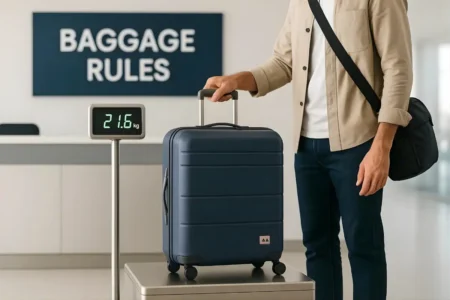
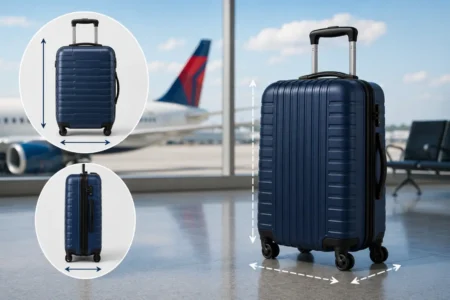
- Carry-on size: Still 22 × 14 × 9 inches (56 × 36 × 23 cm) on most US airlines, including wheels and handles — unchanged, but now measured by automated scanners at a growing number of gates
- Personal items: Must fit fully under the seat with no protrusion — enforcement has tightened noticeably
- Liquids: The 3-1-1 rule is unchanged at standard checkpoints; CT scanner lanes at some major airports no longer require removing liquids from your bag
- Batteries: Spare lithium batteries and power banks must travel in carry-on only, never checked — this rule dates to 2018 but is now checked more consistently
- Smart luggage: Any built-in battery must be removable by hand, without tools, or the bag isn’t permitted
- ID: A REAL ID-compliant license, passport, or other TSA-accepted ID is required for domestic flights; travelers without one can use TSA’s paid Confirm.ID verification process
Editor’s Pick: A Carry-On That Already Meets the 22 × 14 × 9 Limit
Since automated scanners now catch borderline bags that used to slide by, it’s worth starting with a carry-on that meets the limit exactly rather than hoping yours clears the sizer.
Samsonite Omni PC Hard side Carry-On — Hands-On Tested by us Overall dimensions including wheels and handles: 22″ × 15″ × 9.5″; packing dimensions: 19″ × 14.5″ × 9.5″; weight: 6.81 lbs. We measured this ourselves against airline sizers during our 6-week test — its 15″ width runs slightly over the 14″ some US airlines specify, so it’s worth checking your airline’s exact allowance if you’re flying at the margin. Full write-up: our Samsonite Omni PC review. 👉 Check price on Amazon
BAGSMART Carry-On Luggage 20″ Expandable Spinner — Research-based pick Listed at 22″ × 14″ × 9″, an exact match for the standard US carry-on allowance. We haven’t hands-on tested this model yet. 👉 Check price on Amazon
Wrangler Hardside Spinner Luggage, Carry-On 20-Inch — Listed at 22″ × 14″ × 9.5″, 6.4 lbs, 38L capacity, 100% ABS shell. Length and width match the standard allowance exactly; depth runs half an inch over the 9″ some airlines specify, so it’s worth confirming your airline’s exact limit if you’re packing it full. We haven’t hands-on tested this model yet. 👉 Check price on Amazon
Watch out for: The Amazon Basics 21” Hardside Carry-On is popular but runs oversized at roughly 21.7″ × 14.8″ × 10″ — over the 14″/9″ width and depth allowance on most US airlines, despite the “21-inch” name suggesting it’s carry-on friendly. Measure before you buy, not after you’re at the gate.
What’s Actually New: Automated Enforcement
The biggest practical change in 2026 is automated bag-sizer scanning. United has rolled out scanners at 35+ airports, with American and Delta running pilots at major hubs.
These scanners measure a carry-on’s exact dimensions at the gate before boarding — there’s no gate agent making a judgment call on a bag that “looks close enough.”
What this means in practice: a bag that’s half an inch over the limit, which might have boarded without comment in past years, now gets flagged consistently.
If your bag is borderline, measure it packed — with the handle extended and wheels included — before you leave for the airport, not after you’re already at the gate.
Personal Items Are Being Checked More Closely
Airlines have always required personal items to fit under the seat, but enforcement used to be inconsistent. That’s changed. Gate agents are now more likely to flag a bag that’s oversized, overstuffed, or that requires force to slide under the seat.
The practical test: your personal item should slide fully under the seat in front of you with nothing protruding into the aisle.
If you have to angle it, compress it, or push it in stages, it’s borderline — and increasingly likely to get reclassified as a carry-on, which can mean an added fee on airlines that charge for carry-ons.
Lithium Batteries and Smart Luggage
This rule isn’t new — it’s been in place since 2018 under FAA fire-safety guidance — but it’s being enforced more strictly in 2026.
- Spare lithium-ion batteries (power banks, camera batteries, spare laptop batteries) must travel in carry-on luggage only. They are not permitted in checked bags.
- Any suitcase with a built-in battery must have a battery that’s removable by hand, without tools. If the battery requires a screwdriver or similar tool to remove, the bag isn’t permitted on US flights, in carry-on or checked baggage.
If you own smart luggage, confirm the battery pops out easily before your next trip. If it doesn’t, remove it permanently or plan to travel with a different bag.
Liquids: Mostly Unchanged
The standard 3-1-1 rule still applies at most checkpoints: containers of 3.4 oz (100 ml) or less, all fitting in one clear quart-sized bag, one bag per traveler.
The one meaningful change is at airports with CT (computed tomography) scanners — now active at a growing number of major hubs including Chicago O’Hare, Dallas-Fort Worth, and Miami.
At these checkpoints, you typically don’t need to remove liquids or laptops from your bag; the scanner sees through your bag in 3D. TSA staff will tell you at the lane entrance whether removal is required at that specific checkpoint.
For a full breakdown of what counts as a liquid and which airports have CT scanners, see our complete TSA liquid rules guide.
ID Requirements
A REAL ID-compliant driver’s license, a US passport, a passport card, or another TSA-accepted form of ID (military ID, DHS trusted traveler cards like Global Entry or NEXUS) is required to fly domestically. Look for the star marking in the upper right corner of your license to confirm it’s REAL ID-compliant.
If you arrive at a checkpoint without an accepted form of ID, TSA offers a paid identity-verification alternative called Confirm.ID, which carries a non-refundable fee and additional processing time.
We cover the fee amount, what it covers, and how the process works in our dedicated guide to the Confirm.ID fee.
Mobile driver’s licenses in Apple Wallet or Google Wallet are accepted at some airports and checkpoint lanes, but the rollout is partial. Carry a physical REAL ID or passport as a backup even if you plan to use a mobile ID.
How to Prepare
- Measure your packed carry-on — handle extended, wheels included — against your airline’s stated limit before you leave home.
- Confirm your personal item slides fully under an airline seat without force; a home test with a similar-height chair works if you don’t have easy access to a plane seat
- If you own smart luggage, verify the battery is hand-removable
- Keep all spare batteries and power banks in your carry-on or personal item, never in a checked bag
- Carry a physical REAL ID or passport even if you plan to use a mobile ID or facial recognition
Frequently Asked Questions
Has the TSA carry-on size limit changed in 2026?
No. The standard remains 22 × 14 × 9 inches (56 × 36 × 23 cm) on most US airlines, including wheels and handles. What’s changed is enforcement — automated scanners now measure bags at the gate on a growing number of routes.
Can I bring lithium batteries in my carry-on?
Yes — spare lithium-ion batteries and power banks are allowed in carry-on luggage only, never in checked bags. This has been an FAA rule since 2018.
Do I need a REAL ID to fly domestically in 2026?
You need a REAL ID-compliant license, a passport, or another TSA-accepted form of ID. Travelers without an accepted ID can use TSA’s Confirm.ID process for a fee — see our full breakdown of that fee for details.
Are airlines actually enforcing carry-on rules more strictly?
Yes, particularly at airports where automated bag-sizer scanners are in use. A bag that was borderline-compliant in past years is more likely to be flagged in 2026.
Related Guides
- What Counts as a Liquid at TSA? (The Complete 2026 List)
- US Domestic Airlines Carry-On Rules
- How Strict Are Airlines About Carry-On Size?
Source: tsa.gov

16 Comments
So what are the new measurements????
There is no single global carry-on size standard.
While 56 × 40 × 23 cm (22 × 15.7 × 9 inches) is often cited as an international guideline, many major airlines enforce narrower width or depth limits.
For example, American Airlines, United, Delta, Alaska, JetBlue, Cathay Pacific, Etihad, Virgin Atlantic, Virgin Australia, WestJet, Hawaiian, Philippine Airlines, and others limit carry-ons to 56 × 36 × 23 cm (22 × 14.2 × 9.1 inches).
Some airlines are even stricter:
Qatar Airways: ~50 × 37 × 25 cm (≈19.7 inches long)
Sunwing: ~51 cm (≈20.1 inches long)
Ryanair, Korean Air, Air China, Condor, Icelandair, and many EU low-cost carriers: depth often capped at 20 cm (7.9 inches) instead of 23 cm.
Bottom line: Always check your airline’s published limits. A bag marketed as “international carry-on” may still be rejected at the gate.
Please point to an authoritative discussion of these claimed “new bag size” limits. Everything we’ve seen so far comes from third parties on YouTube and on discussion forums, but I can’t find anything on any government web site claiming that all this is about to happen.
No federal rule exists.
TSA/FAA regulate security (what’s inside), not size. Airlines set the size limits:
United Airlines (22 x 14 x 9 in): united.com/en/us/fly/baggage/carry-on-bags.html
American Airlines (22 x 14 x 9 in): aa.com
The ‘new rule’ is stricter airline enforcement of these existing limits.
Could you provide links to tsa.gov which state these changes? All of your links are to your own webpage. Many people are skeptical (rightfully so). It would be great if we have something more authoritative to back up these rules. Thanks!
united.com/en/us/fly/baggage/carry-on-bags.html
Is there a TSA link for these new rules? What is the new weight limit for carry-on?
Size dimensions of carry-on baggage allowed in the cabin of the aircraft vary by airline. Contact your airline to ensure what can fit in the overhead bin or under the seat in front of you.
Yes — you can refer to the official TSA) website. Their main carry-on / baggage policy page is a good start.
tsa.gov/travel
It’s a little odd that this is written about TSA, based in the United States, but the measurements are metric. We didn’t buy into that. I’m a tad touchy about it because I wasted hours upon hours of brain power learning that system as an elementary student in the early 70’s.
You are absolutely right, and I sincerely apologize for the ’70s-style brain power’ drain! I can only imagine how frustrating it was to learn a system that was supposed to be the ‘future’ but never quite took over here in the States.
I originally used metric because aviation follows many international standards, but you’re 100% correct—for a guide about the TSA, it should absolutely lead with inches and pounds. I have updated the article to include both measurements so no one has to do any extra math. Thanks for reading and for keeping me on my toes!
what is the checked luggage size being allowed for 2026? Has that changed?
Thank you
The checked luggage size limit is 62 linear inches (the sum of the length, width and depth of the bag) for most airlines.
The most common weight limit for checked luggage is 50 pounds per bag.
Checked baggage fees can vary by airline, destination and length of flight.
Dude, you messed me up. You said 22x16x9 but I checked on airlines websites and they’re almost all saying 22 x 14 x 9 in. I’ve spent hours looking for luggage based on what you said and almost bought the wrong size. Please fix that going forward. Thanks! And otherwise, thanks for the rest of the info which looks great!
Really appreciate the constructive feedback—and I’m glad the rest of the information was useful.
You’re absolutely right, and thanks for flagging this. The carry-on size most airlines follow is 22 × 14 × 9 inches, not 22 × 16 × 9. I appreciate you taking the time to double-check directly with airline websites, and I apologise for the confusion this may have caused while you were shopping for luggage. Safe travels! ✈️
Your article covers a lot of good information.
Issues:
“Airlines have agreed on a single global carry-on size for most cabins:
56 cm tall, 40 cm wide, 23 cm deep.”
AA and a dozen other airlines have 56x36x23 = 22×14.2×9.1.
(american, alaska, cathay pac, china, delta, etihad, hawaiian, jetblue, philippine, united, virgin aus+atlantic, westjet +) Qatar has 19.7 instead of 22, sunwing has 20.1. Air china, condor, iceland, korean, ryan, and many low cost EU airlines have 7.9 instead of 9.1.
“Starting on May 7, 2025, and becoming tougher in 2026, you must have either: A Real ID compliant driver’s license, or A valid passport”
OR a passport card. Highly recommended. A drivers license is not proof of citizenship, it only shows your home state and address, and Real ID compliant drivers license is not legally needed anywhere at any time unless your state mandates it. I recommend opting out if possible. Real ID is federal government overreach, backed by propaganda that you must get one. You only need a passport or a passport card to fly domestically, and a passport book to fly internationally.
Thank you for the correction. You’re right—there is no single global carry-on size, and several airlines apply stricter width or depth limits than the commonly cited guideline. The article has been updated to reflect these differences. We’ve also clarified that a passport or passport card may be used in place of a REAL ID for domestic U.S. flights and removed the reference to 2026 enforcement. We appreciate you bringing this to our attention.