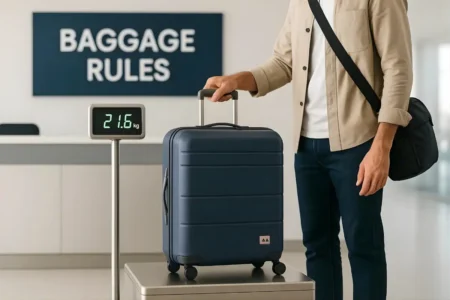
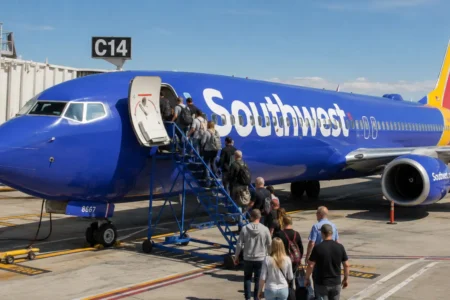
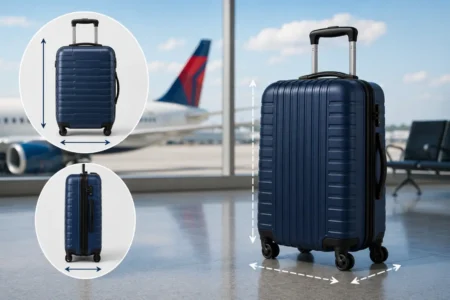
You’re at the gate. Two people ahead of you just got their rollers pink-tagged. A flight attendant is already announcing full overhead bins — and Group 8 hasn’t even started boarding yet.
That’s the moment this guide is built to prevent.
Delta’s written carry-on rules are genuinely simple. It’s the gap between the policy page and what actually happens at Gate B24 that costs travelers time, money, and the connection they were counting on.
This guide covers every dimension, every exception, and every enforcement reality so you board with confidence.
Quick Answer: Delta Carry-On Rules 2026
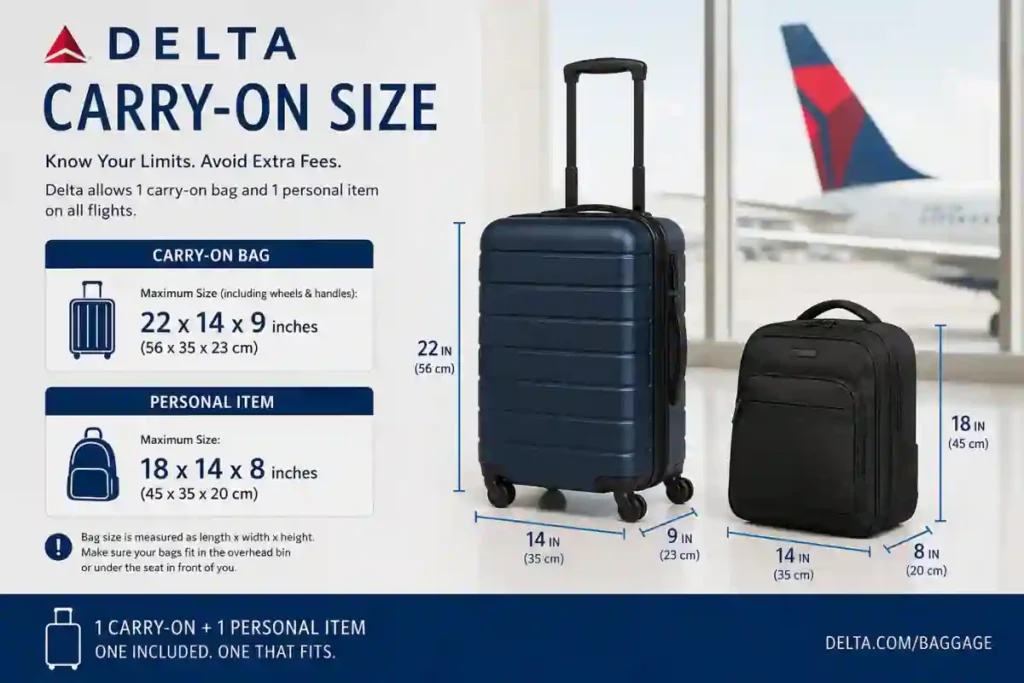
Size limit: 22 × 14 × 9 inches (56 × 35 × 23 cm) — 45 linear inches total, wheels and handles included.
Personal item: Must fit completely under the seat in front of you.
Delta Main Basic (formerly Basic Economy): Carry-on allowed on domestic U.S. routes — but Group 8 boarding makes bin access near-impossible in practice. On transatlantic routes to/from Europe: personal item only, no carry-on.
Delta Connection (50 seats or fewer): Carry-on gets a pink “Gate Claim/Planeside” tag at the door. Returned to you on the jetbridge when you deplane — not at baggage claim.
| Fare / Situation | Carry-On? | Personal Item | Gate Check Risk |
|---|---|---|---|
| Main Classic (standard economy) | ✅ Free | ✅ Yes | Low — board in Groups 3–5 |
| Delta Main Basic — Domestic | ✅ Free on paper | ✅ Yes | Very high — Group 8, bins full |
| Delta Main Basic — Transatlantic | ❌ No | ✅ Yes | Automatic if you bring one |
| Delta Connection (51+ seats) | ✅ Yes | ✅ Yes | Moderate — bins are tighter |
| Delta Connection (≤50 seats) | ❌ No (pink-tagged) | ✅ Yes | Automatic every time |
| Comfort+ / First / Delta One | ✅ Free | ✅ Yes | Very low — board in Group 1 |
Delta Carry-On Size Limit 2026: The Exact Measurements
Delta’s carry-on allowance is 22 × 14 × 9 inches — or 56 × 35 × 23 cm — totaling exactly 45 linear inches. That’s the sum of all three dimensions, and it’s the standard shared by most major U.S. carriers.
The part that surprises people at the sizer box: those numbers cover the complete, external bag — not the main compartment alone.
Wheels, telescoping handles, side-zip pockets, frame protrusions, and attached straps all count toward your measurement. A bag listed as “21 inches” on the product page can easily measure 22.5–23 inches total once spinner wheels and handle housing are added.
| Dimension | Inches | Centimeters |
|---|---|---|
| Length | 22 in | 56 cm |
| Width | 14 in | 35 cm |
| Depth | 9 in | 23 cm |
| Linear total | 45 in | 114 cm |
International weight exceptions: Delta publishes no weight limit for carry-ons on most routes. Two exceptions: Singapore routes cap carry-ons at 7 kg (15 lbs); Beijing and Shanghai routes cap them at 10 kg (22 lbs). All other domestic and international routes have no published carry-on weight limit.
Aircraft bin size reality: Not all Delta aircraft are equal. The A220 has the widest overhead bins on Delta’s narrow-body fleet — bags that barely pass on other planes have real clearance there.
The 737-800 and -900 are middle-ground. On legacy 737-700s and CRJ variants, bins are significantly tighter. Knowing your plane matters more than knowing the rules.
Delta Personal Item Rules: What Fits Under the Seat
Delta publishes no official dimensions for personal items. The single rule: it must fit completely under the seat in front of you.
In practice, most under-seat spaces on Delta’s mainline fleet (737, A220, A321) fit bags roughly 18 × 14 × 8 inches or smaller. That’s not an official number — it’s the real-world constraint based on seat undercarriage dimensions.
Bulkhead rows and some exit rows have no under-seat space at all; your personal item would need to go overhead, using your carry-on slot.
Personal items that reliably work:
- Small backpacks or slings (under 20L when packed — the volume, not the label, is what matters)
- Standard purses and tote bags
- Laptop bags up to a 15-inch sleeve
- Camera bags in compact configurations
- Slim duffel bags not stuffed beyond their frame
What tends to get rejected or redirected overhead:
- Fully loaded 20L+ daypacks (they fit when empty; overpacking is the issue)
- Any rigid-frame bag wider than roughly 14 inches
- “Personal item-sized” bags stuffed with shoes, an extra outfit, and a laptop
The insider move that frequent flyers use: Pack your valuables, medications, travel documents, and laptop into the personal item — not the carry-on.
If you’re flying Main Basic and your carry-on gets gate-checked, your under-seat bag never leaves your possession.
If you’re flying basic economy or budget airlines, check out my guide to the best 18x14x8 personal item bags that actually fit under the seat and help avoid surprise fees.
Delta Main Basic Carry-On: The Boarding Group Math
In 2026, Delta rebranded its cheapest fare from “Basic Economy” to Delta Main Basic. Same rules. New name.
On Domestic U.S. Flights: Allowed in Policy, Unlikely in Practice
Delta Main Basic passengers get one free carry-on bag on domestic routes. Delta promotes this as a differentiator over United — and it genuinely is, on paper.
Here’s the catch: Main Basic boards in Group 8 — the last boarding group.
By the time Group 8 is called, overhead bins on most full flights are already stuffed. Flight attendants start making bin-full announcements around Group 5 on high-load routes like ATL–LAX and JFK–ORD.
Some agents start pre-emptively tagging bags before any bins are actually full, just to speed boarding — Delta has confirmed this practice exists.
What this means at the gate:
- Your carry-on will most likely be gate-checked to your final destination at no charge
- That means baggage claim instead of a fast exit — add 20–30 minutes
- If your bag is flagged as oversized, the fee jumps to $35–$65 (per Delta’s checked baggage fee schedule), and that charge is non-negotiable once applied
- If your bag is compliant and gate-checked only for space reasons, retrieval is free
The practical Main Basic strategy: Pack a personal item that genuinely fits under the seat. Leave the carry-on at home. You’ll walk past the Group 1–7 bin scramble like you’ve done this before — because you have.
Worth doing the math: upgrading from Main Basic to Main Classic on short domestic routes is often $15–$30. If you check a bag, that fee gets absorbed. If you’re carrying on, earlier boarding is worth real money in time and stress.
Delta Main Basic Boarding Group Order (2026)
| Group | Who Boards | Bin Space Remaining |
|---|---|---|
| 1 | Delta One, First Class, Diamond Medallion | Full availability |
| 2 | Platinum / Gold Medallion, Sky Priority | Nearly full |
| 3 | Silver Medallion, Delta Amex cardholders | Good |
| 4 | Comfort+ | Good |
| 5 | Main Classic (standard economy) | Filling |
| 6 | Main Classic (continued) | Limited |
| 7 | SkyMiles members without status | Very limited |
| 8 | Delta Main Basic | Typically none |
On Transatlantic Routes to/from Europe: No Carry-On at All
This rule catches travelers who researched domestic policy and assumed it applied everywhere. Booking Delta Main Basic from JFK, ATL, BOS, or LAX to any European destination means personal item only — no full-size carry-on. A carry-on brought to the gate will be checked, and fees apply.
Always verify at delta.com for your specific fare and route before packing for any transatlantic trip.
How Delta Compares to United and American (2026)
| Airline | Basic Economy Carry-On | Boarding Position | Bin Access Reality |
|---|---|---|---|
| Delta | ✅ Free on domestic | Group 8 (last) | Near-impossible on full flights |
| American | ✅ Free on domestic | Group 8–9 (last) | Near-impossible on full flights |
| United | ❌ Not allowed | N/A | Personal item only — no question |
United’s restriction is a hard ban. Delta and American allow it but engineer boarding order so it’s effectively useless on full flights.
Budget traveler? Read our US domestic airlines carry-on rules before you book — the right fare on the right route changes everything.
Delta Connection Regional Flights: The Pink Tag, Explained Correctly
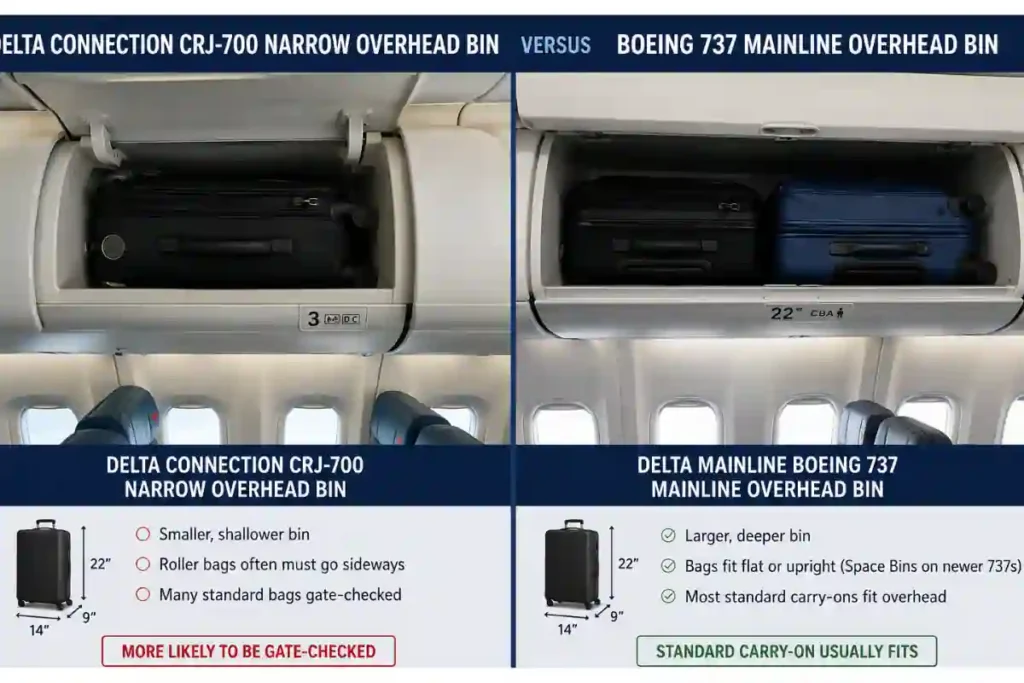
Your booking confirmation shows “operated by SkyWest” or “operated by Endeavor Air.” One line. Huge difference.
Delta Connection regional jets — primarily the CRJ-700, CRJ-900, and Embraer E170/E175 — have significantly narrower overhead bins than mainline Boeing and Airbus aircraft.
CRJ bins are designed for bags stored wheels-first horizontally, and a standard 22-inch roller often cannot physically fit upright or at all.
Flying Delta soon? Check the updated Delta baggage fees before you pack.
On Flights with 50 Seats or Fewer: Pink Tag Is Automatic
On Delta’s smallest regional aircraft, official policy allows personal items only in-cabin. Your carry-on receives a pink “Gate Claim/Planeside” tag at the boarding door.
Here’s what most travel guides get wrong about what happens next:
The bag is loaded in cargo below the aircraft. When you deplane, it is waiting for you on the jetbridge — not at the baggage carousel.
You step off the jet, walk three feet onto the jetbridge, and your bag is sitting on a ramp cart. No baggage claim. No waiting. That’s the “planeside” part of the official tag name — Delta uses this language directly in their own baggage FAQ.
On Larger Regional Jets (51+ Seats)
Technically, carry-ons are permitted. In practice, agents frequently pink-tag bags anyway because overhead bin space is still far tighter than on mainline aircraft. Compliant 22-inch bags get tagged on these routes regularly.
A real example: Flying ATL to SAV on a CRJ-900. You’ve carried this same 21-inch Away bag a hundred times on mainline flights without a problem.
The gate agent pink-tags it before you board without measuring it — the CRJ-900 bins simply can’t accommodate standard rollers upright.
You pick it up on the jetbridge in Savannah, 90 seconds after deplaning. It’s fine. But it surprises you every time if you didn’t know to expect it.
How to protect yourself on regional routes:
- Check the aircraft type in your booking or the Fly Delta app the night before — CRJ or ERJ in the code means expect a tag
- Soft-sided bags compress slightly; they have a modestly better chance on 51+ seat regionals
- On ≤50-seat flights, transfer anything you’ll need during the flight into your personal item before you get to the gate
- If you’re connecting (mainline first leg, regional second leg), you’ll still pick up at the jetbridge on arrival — not baggage claim — unless the agent tags it to final destination instead
Does Delta Have a Carry-On Weight Limit?
For most flights, no. Delta doesn’t publish a maximum carry-on weight for domestic routes and doesn’t weigh bags at the gate.
Published exceptions:
- Singapore: 7 kg (15 lbs) maximum per carry-on
- Beijing / Shanghai: 10 kg (22 lbs) maximum per carry-on
- Codeshare partner flights operate under the partner carrier’s rules — check your specific itinerary
The Practical Weight Limit That Isn’t Written Down
There’s an operational constraint that functions exactly like a weight limit even though it appears nowhere in Delta’s policy:
You must be able to lift your bag into the overhead bin completely unassisted.
Flight crew is not required to help you hoist a 50-pound bag overhead. If you’re visibly struggling, a gate agent or flight attendant has the discretion to gate-check the bag on the spot.
This isn’t uniformly enforced — but it happens on full flights where boarding speed matters, and it’s always non-negotiable once a tag is applied.
Test before you leave home: can you lift the packed bag overhead with one arm while standing? If the answer is no at your kitchen counter, the answer is still no at Gate C12 at 6 AM after a connection.
How Delta Enforces Carry-On Rules in 2026
Enforcement is tighter than pre-pandemic, especially at major hubs. These are the exact mechanisms you’ll encounter:
The metal sizer box. Many Delta gates — consistently at ATL, JFK, LAX, and SEA — have a physical metal frame at the podium. Your bag must drop into it cleanly with the handle collapsed and no forcing.
Atlanta enforces most aggressively in the network; a bag that passed without comment at a regional airport may not pass at Hartsfield.
Gate agent visual profiling. Experienced agents identify oversized bags from 20 feet away. Common triggers: a hard-shell bowed outward at the sides, a soft-sided bag with seams clearly straining, or two smaller bags bundled together to look like one carry-on. Gate agents aren’t out to ruin your trip — they’re managing boarding speed under time pressure, and they’ve seen every trick.
Boarding group timing. Groups 1–3 almost never face bag scrutiny. By Groups 6–8, agents are actively filtering because they know bin space is gone. The later you board, the more any borderline bag gets noticed.
Pre-boarding gate checks. Delta has confirmed it sometimes tags bags before bins are actually full to speed boarding on high-load flights. Legal. Common. Non-negotiable after the tag goes on.
Medallion status matters here. Diamond and Platinum Medallion members essentially never get bag-checked — early boarding guarantees bin access and agents rarely scrutinize them. Silver members board early but still face scrutiny if the bag is obviously oversized. Main Basic passengers face the most enforcement pressure of anyone.
What Bags Actually Fit Delta’s Sizer Box?
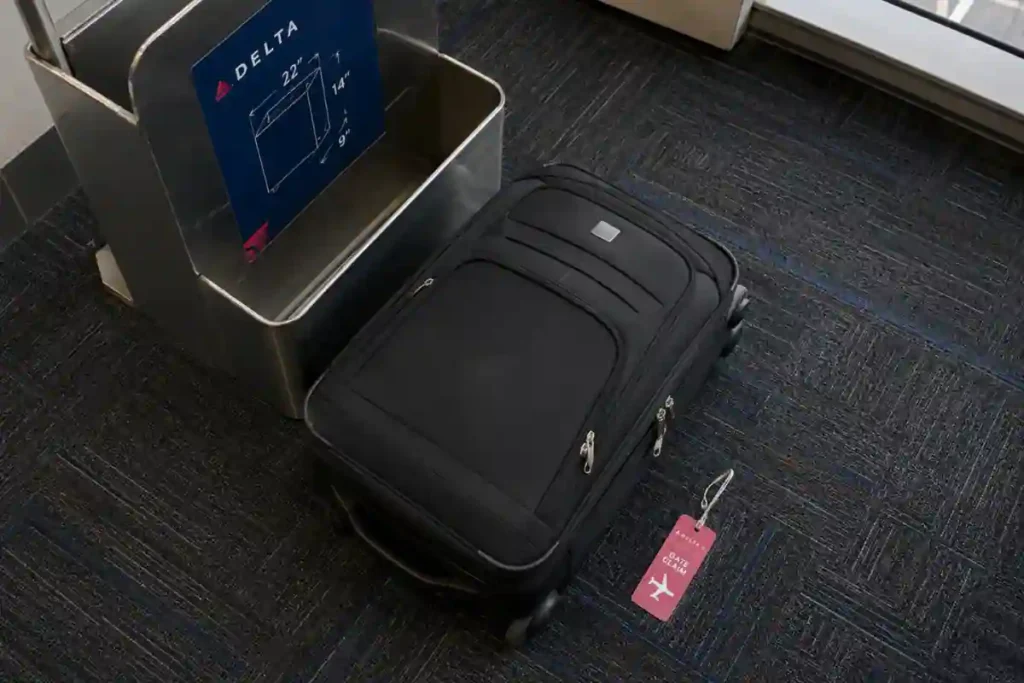
Soft-sided bags are more forgiving. A quality nylon or polyester spinner rated at 22 inches will flex just enough under gate-box pressure to pass, even when firmly packed. The fabric gives; the dimension listed on the tag is usually conservative.
Hard-shells with expansion zippers are the most common gate-check cause. Unzip the expansion panel even one inch, and a 22-inch hard-shell becomes a 24-inch bag. The sizer box doesn’t know or care what it measured empty at the factory — it measures what you’re holding right now.
Some bags marketed as “airline carry-on approved” are measured without wheels and handles. Always verify total external dimensions including all protrusions before buying. Look for listings that specifically state “wheel-included measurement.”
Brands that publish wheel-included measurements: Travelpro, Away, Monos. If a product listing doesn’t specify, assume the listed dimension is for the main compartment only — add 1–1.5 inches for wheels.
Pre-Boarding Carry-On Checklist
Run this the night before you fly:
- Total external measurement (wheels and handles included) is 22 × 14 × 9 inches or less
- Expansion zipper is fully closed and will stay closed during the flight
- External pockets aren’t stuffed outward beyond the bag’s frame
- You can lift it overhead with one arm without struggling
- If flying any regional connector: bag is 20 inches or smaller, or you’re prepared for a planeside tag
What to Do When Your Carry-On Gets Gate-Checked
This is the section no other travel guide includes — and it’s the one you actually need when you’re standing at the boarding door with a pink tag in your hand.
Before you hand the bag over, do this immediately:
- Remove your laptop or tablet — cargo hold is not pressurized the same way; more importantly, checked baggage handlers don’t know it’s in there
- Remove all medications — always, no exceptions
- Remove travel documents and passport if stored in the carry-on
- Remove any AirTag or Bluetooth tracker — or confirm it’s set to track as a “checked item” so you can locate it on arrival
- Remove fragile items — gate-checked bags go into cargo with checked luggage; they’re handled accordingly
- Remove your phone charger and headphones if it’s a long flight
- Ask the agent whether you’ll retrieve the bag at the jetbridge or baggage claim — on mainline flights it’s baggage claim; on regional ≤50-seat jets it’s the jetbridge on arrival
On connecting flights: Ask the agent to tag the bag to your final destination, not the connecting airport. Delta usually does this automatically, but confirming takes 10 seconds and saves a possible missed-connection baggage scramble.
5 Delta Carry-On Tips From Frequent Flyers
1. Use your Delta SkyMiles Amex card’s early boarding perk. Delta’s co-branded Amex cards (Gold, Platinum, and Reserve) include Zone 1 / Group 3 boarding on Delta flights regardless of fare class — including Main Basic. That’s the single highest-value perk for avoiding gate checks. Bin space is first-come, first-served, and Group 3 boards while bins still have room. Check our [Delta Amex card comparison] to see which card makes sense for your travel frequency.
2. Use compression packing cubes — especially for the 9-inch depth. The depth dimension (9 inches) is the one that actually fails people at the sizer box, not the length. Compression cubes collapse clothing flat enough that your bag maintains its spec under gate scrutiny rather than just appearing to. The difference between a clear pass and a close call is often half an inch of compressed clothes. Full technique: [how to pack a carry-on bag efficiently].
3. Wear your heaviest layers through security. A fleece, jacket, and thick-soled shoes can add 4–6 lbs to a bag. Wear them. They don’t count toward your bag’s dimensions, they don’t get weighed, and they pass security just fine. That’s free space and free weight savings.
4. Check your aircraft before you pack — takes 90 seconds. Open the Fly Delta app or your booking confirmation. Look for the aircraft type. Mainline aircraft (737, A220, A321) = standard bin space. CRJ or ERJ in the code = smaller bins, possible planeside tag. This one check eliminates the most common gate-check surprise Delta travelers experience.
5. Never expand a hard-shell bag you’re carrying on. The expansion feature exists for bags that are being checked. If you unzip a 22-inch hard-shell’s expansion panel, it becomes a 24-inch bag and will fail the sizer — guaranteed. If you need the extra space, check the bag. If you’re carrying on, the expansion zipper stays shut, no exceptions.
Frequently Asked Questions
Can I bring a carry-on on Delta Basic Economy?
On domestic U.S. routes, yes — Delta Main Basic includes one free carry-on bag. However, Main Basic boards last (Group 8). On most full flights, overhead bins are already full by Group 5–6. Your carry-on will likely be gate-checked at no charge, but you retrieve it at baggage claim. On transatlantic routes to Europe, Main Basic allows a personal item only — no carry-on. A carry-on brought to a transatlantic gate will be checked, with fees applying.
What is the Delta carry-on size limit in Centimetres?
Delta’s carry-on limit is 56 × 35 × 23 cm (22 × 14 × 9 inches), totalling 114 cm or 45 linear inches. That measurement covers the entire external bag — wheels, handles, and all protrusions included. The 23 cm / 9-inch depth is the dimension most commonly violated by expanded hard-shell bags.
Does Delta weigh carry-on bags?
No published weight limit exists for domestic routes, and Delta doesn’t weigh bags at the gate domestically. Exceptions: Singapore routes cap carry-ons at 7 kg (15 lbs); Beijing and Shanghai routes at 10 kg (22 lbs). On all other flights, the practical constraint is whether you can lift the bag overhead unassisted — gate agents can check bags that passengers visibly can’t lift.
What happens if my carry-on is too big for Delta’s sizer box?
If your bag fails the sizer box before boarding, the gate agent assesses it as an oversized bag. Fees typically run $35–$65 — the same range as Delta’s standard first checked bag fee. If your bag is the correct size but there’s simply no bin space left, it gets gate-checked for free, retrieved at baggage claim.
How does the Delta Connection pink tag work?
On Delta Connection flights with 50 seats or fewer, only personal items are allowed in the cabin. Carry-ons receive a pink “Gate Claim/Planeside” tag at the boarding door, are loaded in cargo below the aircraft, and are returned to passengers on the jetbridge immediately upon deplaning — not at the baggage carousel. On larger regional jets (51+ seats), carry-ons are technically permitted but frequently get tagged anyway due to limited bin space; same jet bridge retrieval applies.
How does Delta compare to United and American on Basic Economy carry-ons?
Delta: Carry-on free on domestic routes for all fares including Main Basic; blocked on transatlantic Europe routes. Group 8 boarding makes bin access near-impossible in practice on full flights.
United: Basic Economy passengers cannot bring a full-size carry-on on domestic flights — personal item only, hard restriction regardless of boarding order.
American Airlines: Carry-on included on domestic Basic Economy fares (current as of 2026). AA boards Basic Economy last (Group 8–9), creating the same real-world bin shortage as Delta. As of May 18, 2026, AA added a $5–$10 surcharge on checked bags for Basic Economy passengers.
If my carry-on gets gate-checked, will I miss my connection?
Gate-checked bags on mainline flights go to baggage claim and are tagged to your final destination — not the connecting airport. You don’t need to retrieve them mid-connection.
If you’re on a regional jet with a planeside tag, the bag is returned at the jetbridge at that airport; if connecting, ask the agent to tag it through to final destination before you board. Always confirm this explicitly if your connection is under 60 minutes.
The Bottom Line
Delta’s carry-on rules are among the most reasonable in the U.S. — no arbitrary weight limits on most routes, carry-on included even on the cheapest fares domestically, and a pink tag system that returns bags to you on the jetbridge rather than sending you to baggage claim.
The friction is real, but it’s navigable once you understand it:
- Measure your bag including wheels and handles. Most gate-check surprises come down to an inch of wheels no one accounted for.
- Main Basic means you probably won’t get to use your carry-on allowance on full flights. Pack your under-seat bag like it’s your only bag.
- Check your aircraft the night before. Two minutes of prep saves 20 minutes at baggage claim.
- If you get gate-checked, pull out your laptop, medications, and passport before handing it over. That’s the move nobody tells you about until you need it.
Pack smart, board early when you can, and you’ll spend your travel energy on the destination instead of the jetbridge.
Sources: Delta Air Lines official baggage FAQ (delta.com/baggage-faqs), Delta carry-on baggage page, Delta fare class documentation. Competitor policy data from American Airlines and United Airlines official baggage pages. All verified May 2026.
Also See:-