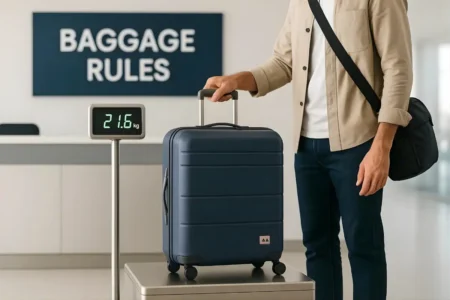
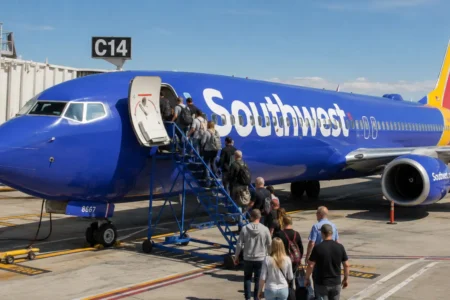
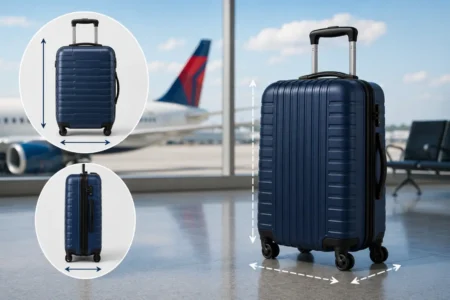
Quick answer: Most airlines allow 22×14×9 inches for carry-ons — but that number hides a catch most travelers miss on Basic Economy fares (see below), and at least one budget carrier’s fee jumps depending on exactly when you book.
Not sure your current bag will survive the new gate-check crackdown? Samsonite Freeform Hard side Carry-On →
Update, July 2026: Spirit Airlines permanently ceased all operations on May 2, 2026. This guide has been updated to remove Spirit-specific booking advice. If you previously flew Spirit for its low fares, Frontier and Allegiant now cover most of the same routes — both are covered in detail below.
Carry-on rules haven’t changed much since 2022 — what’s changed is enforcement. Automated bag scanners, jetway checks, and gate agents under pressure to manage bin space mean the gate-check fee that used to happen to other people is now happening to everyone with an oversized or unpaid bag.
This guide covers every active US domestic airline, verified directly from official airline sources in July 2026 — use the table below to find your airline fast, or jump to the FAQ for quick answers.
US Domestic Airlines Carry-On Rules at a Glance
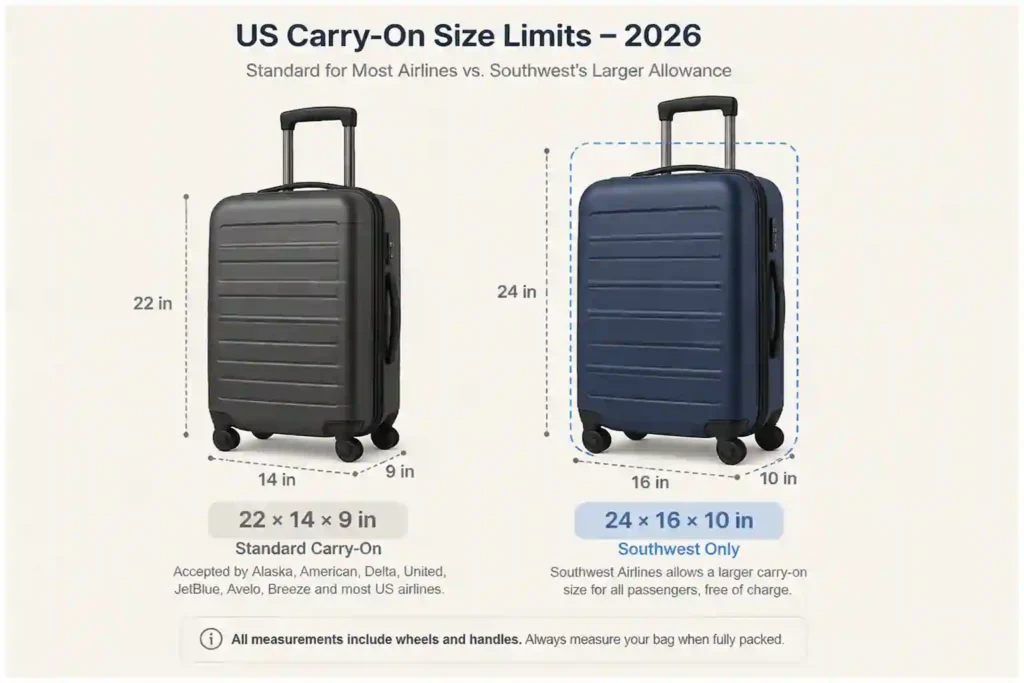
All sizes include wheels and handles at full extension. A suitcase labeled “22 inches” by the manufacturer often measures 23.5–24 inches once the telescoping handle and base wheels are included. Measure your packed bag — not the empty shell.
💡 Tip: A travel inspira Digital Luggage Scale ($8–$15) pays for itself the first time it saves you a gate-check fee — throw it in your bag before every trip.
| Airline | Carry-On Size | Fee | Personal Item | Key Rule 2026 |
|---|---|---|---|---|
| American | 22×14×9″ | Free | 18×14×8″ | Basic Economy: personal item only |
| Delta | 22×14×9″ | Free | 18×14×8″ | Basic Economy: personal item only |
| United | 22×14×9″ | Free | 17×10×9″ | Basic domestic: personal item only |
| Southwest | 24×16×10″ | Always free | 18.5×13.5×8.5″ | No restrictions — most generous US airline |
| JetBlue | 22×14×9″ | Free | 17×13×8″ | Blue Basic: personal item only |
| Alaska | 22×14×9″ | Free | 17×13×6″ | Saver fare: personal item only |
| Frontier | 24×16×10″ | $35–$79 | 18×14×8″ (free) | Gate fee is $79 |
| Allegiant | 22×16×10″ | $10–$75 | 18×14×8″ (free) | 25 lb weight limit strictly enforced |
| Sun Country | 24×16×11″ | $30–$50 | 18×14×8″ (free) | Bundle fares include carry-on |
| Hawaiian | 22×14×9″ | Free | 25 lb limit inter-isl. | Smaller bins on inter-island aircraft |
How to measure correctly: Stand your bag upright on the floor. Extend the handle fully. Measure height (floor to top of handle), width (widest point including all pockets and bulges), and depth (front to back at the deepest point). All three must be at or under the airline’s stated limit simultaneously — not one dimension at a time.
How Airline Carry-On Rules Actually Work
The two measurement systems US airlines use
H×W×D in inches — used by American, United, Alaska, JetBlue, and most carriers. The near-universal limit: 22×14×9 inches.
Linear inches — Delta’s preferred format, meaning the sum of all three dimensions. Delta’s limit is 45 linear inches. Since 22+14+9 = 45, this is identical to the standard limit in practice. The only flexibility: you can slightly redistribute inches across dimensions as long as the total stays at 45.
“Including wheels and handles” — why this catches people
Airlines measure the total external footprint of the bag, not the body. The handle extending above the top of the bag and the wheels adding height at the bottom both count.
A 22-inch suitcase (body measurement) is typically 23.5 to 24 inches in total. Always measure your bag fully packed with the handle extended and the bag standing on its wheels before you leave home.
Carry-on vs personal item — the distinction that determines your fee
Every US airline allows two items: one carry-on for the overhead bin and one personal item for under the seat. The personal item is always free on every airline, on every fare class — including Basic Economy. Fees and restrictions only apply to the carry-on.
- Personal item: fits under the seat. Roughly 18×14×8 inches. Backpacks, laptop bags, totes, small duffels.
- Carry-on: overhead bin. Standard 22×14×9 inches. Rolling suitcases, large backpacks, large duffels.
🎒 Looking for a personal item that’s guaranteed to slide under any seat? Our UNDERSEAT PRO 18x14x8 Travel Backpack roundup covers exactly this.
2026 enforcement shift: Agents are now checking that personal items genuinely fit fully under the seat — not just that they look small enough. If it sticks into the aisle, protrudes forward, or requires real force to push under, it gets reclassified as a carry-on. On budget airlines that reclassification carries an added fee.
Full-Service Airlines: Detailed Carry-On Rules
American Airlines
Carry-on: 22×14×9 inches. Personal item: 18×14×8 inches. Both free on every fare except Basic Economy (personal item only). Published weight guideline: 40 lbs — not actively enforced on domestic flights but referenced on international routes.
Basic Economy boarding trap: Basic Economy passengers board last in Group 9. Overhead bins are almost always completely full by then. This usually results in a free gate-check because there is literally no bin space — not a fee, unless your bag is also oversized or non-compliant.
For a deep dive into weight restrictions and sizer leniency, check out our American Airlines carry-on size guide.
Delta Air Lines
Carry-on: 22×14×9 inches (45 linear inches). Personal item: must fit under the seat. Basic Economy: personal item only — no overhead carry-on.
Delta Connection regional jets operate with smaller overhead bins — a bag that fits the standard sizer may not fit on a regional aircraft. Always pack a personal item with essentials when your itinerary includes a Delta Connection segment.
Delta deployed automated bag sizer scanners at major hubs in 2025. These flag oversized bags at the gate before boarding with no gate agent discretion involved.
If you’re checking luggage, see our Delta Checked Baggage Policy 2026: New Fees, Rules & How to Avoid Paying More for the latest fees, weight limits, and money-saving tips.
United Airlines
Carry-on: 22×14×9 inches. Personal item: 17×10×9 inches. Basic Economy domestic: personal item only. Exception: United Basic Economy on international routes (transatlantic, transpacific, South America) does include a carry-on.
United expanded automated bag sizers to 35+ airports in late 2025 and is targeting 80+ locations by end of 2026. These scanners measure carry-ons at the boarding gate and flag non-compliant bags automatically. Bags that always slipped through on visual inspection will now be caught.
Since scanners don’t give second chances, a bag that’s been measured and certified to fit — like the U.S. Traveler Rio Softside Carry-On (4.2★, 36,000+ ratings, well under standard size limits at 21″H x 13.5″W x 7.5″D) — removes the guesswork entirely.
Southwest Airlines
Carry-on: 24×16×10 inches — larger than the US standard. Personal item: 18.5×13.5×8.5 inches. Both carry-on and personal item are free on every Southwest fare. Southwest is the only major US airline with zero carry-on fees and zero Basic Economy carry-on restrictions.
The one real risk: boarding position. Southwest’s open seating means overhead bins fill front-to-back. Travelers in B35 or later on full flights frequently find no bin space left. Buy EarlyBird Check-In or book Anytime or Business Select fares to guarantee early boarding.
If you’re planning to check a bag, see our Southwest Checked Baggage Policy 2026 guide for New Fees, Rules & How to Avoid Paying More for the latest baggage fees, size limits, and packing tips.
JetBlue
Carry-on: 22×14×9 inches. Personal item: 17×13×8 inches. Blue Basic: personal item only. All other JetBlue fares (Blue, Blue Plus, Blue Extra, Mint): carry-on included. JetBlue boards window-seat passengers last — even a compliant carry-on may get gate-checked on a full flight without priority boarding.
Alaska Airlines
Carry-on: 22×14×9 inches. Personal item: 17×13×6 inches. Saver fare: personal item only. Main Cabin and above: carry-on included.
Alaska MVP, MVP Gold, and MVP Gold 75K status members board early — the most practical path to guaranteed bin access on Alaska’s often-full West Coast routes.
Hawaiian Airlines
Carry-on: 22×14×9 inches on mainland routes. Inter-island flights run on smaller aircraft with smaller overhead bins — verify your specific aircraft before packing. A bag that fits a mainline Boeing 717 may not fit an inter-island ATR turboprop.
Weight limit: Hawaiian enforces 25 lbs on carry-on bags for inter-island flights — stricter than virtually every other US airline, most of which publish no carry-on weight limit. Weigh your packed bag if flying inter-island.
Budget Airlines: Fees, Traps, and How to Avoid Both
Warning: Budget airlines (Frontier, Allegiant, Sun Country) do not include a carry-on in their base fares. The fee for adding a carry-on increases significantly the later you pay. Always add the carry-on at initial online booking for the lowest rate. The personal item is always free on all budget airlines.
sic packing cube set can shrink a “carry-on” load down into your free personal item on some budget fares — worth a look at our BAGAIL Compression Packing Cubes Set guide before you pay a carry-on fee at all.
Frontier Airlines
Carry-on: 24×16×10 inches. Personal item (always free): 18×14×8 inches. Fee tiers: $35–$45 online at booking, $45–$59 at check-in, $79 at the gate. Frontier enforces sizer boxes more consistently than legacy carriers.
Bundle fares: The Works and The Perks include carry-on access. On many routes, a bundle fare costs less than base fare plus carry-on fee plus seat selection added individually. Always compare total cost before assuming the base fare is cheaper.
Budget airlines have very different cabin baggage rules from full-service airlines. If you’re flying with a low-cost carrier, read our Budget Airlines Carry-On Rules (Frontier, Ryanair) – 2026 Complete Guide to compare size limits, personal item allowances, and hidden carry-on fees before you travel.
Allegiant Airlines
Carry-on: 22×16×10 inches. Personal item (always free): 18×14×8 inches. Fee tiers: $10–$35 at online booking (cheapest of any US budget carrier when booked early), $35–$50 at check-in, $75 at the gate.
Warning: Allegiant enforces a 25 lb weight limit on carry-on bags — the strictest carry-on weight limit of any US airline. If your Allegiant carry-on exceeds 25 lbs at the gate, you will pay an overweight fee. Weigh your fully packed bag at home before you leave for the airport.
This is exactly the situation a travel inspira Digital Luggage Scale earns its keep — weigh at home, not at the gate.
Sun Country Airlines
Carry-on: 24×16×11 inches (one of the largest carry-on allowances among US carriers). Personal item (always free): 18×14×8 inches. Fee tiers: $30 online, $50 at the gate. Bundle fares include carry-on access. Sun Country is the most lenient of the budget carriers on enforcement.
Avelo Airlines
Personal item: 17×13×9 inches, free. Carry-on: 22×14×9 inches. No published weight cap, but passengers must be able to hoist their carry-on into the overhead bin without help — if you can’t manage it solo at the gate, the bag gets checked with an extra fee attached.
Fee range: $40–$65 depending on timing. Free items include manual wheelchairs, mobility aids, assistive devices, outerwear, and musical instruments.
Breeze Airways
Personal item: 17×14×8 inches, free. Carry-on: 22×14×9 inches. Weight limit: 35 lbs maximum. Fee from $35 (free with ticket bundle).
Breeze ticket bundles fold carry-on access into the fare price — compare the bundle fare total before booking a base fare and paying separately for a bag.
Lithium Batteries and Smart Luggage: The 2026 Rules
Lithium battery rules have existed since 2018. What changed in 2026 is consistent enforcement. Gate agents are trained to check smart luggage batteries.
TSA checkpoints flag power banks in checked bags routinely, and if your carry-on is gate-checked at the last minute, a power bank inside it triggers a mandatory bag retrieval before the aircraft door closes.
The core rule: all spare batteries go in carry-on only
This is an FAA safety rule, not an airline preference. It applies on every US airline, on every flight, with no exceptions.
- Spare lithium-ion batteries (power banks, camera batteries, spare laptop batteries): carry-on only. Never in checked luggage.
- Devices with batteries installed (laptops, phones, cameras): allowed in carry-on AND checked luggage.
- Power banks during flight: must be in your personal item or carry-on bag — not in an overhead bin unattended unless it is in the bag. If your carry-on gets gate-checked, remove your power bank first and carry it on your person into the cabin.
f you’re also traveling with a smartwatch, smart ring, CGM, or insulin pump, the rules can be different from those for spare lithium batteries. See our TSA Wearable Device Rules 2026: Apple Watch, CGM, Smart Ring & Insulin Pump — What’s Changed for what to expect at the security checkpoint.
Need a compliant power bank? Our Anker Prime Power Bank (27,650mAh / 99.4Wh) list is filtered specifically so you never have to do the watt-hour math at the gate.
Watt-hour limits — the numbers you need to know
Every battery has a watt-hour (Wh) rating on the label. If yours shows only milliamp-hours (mAh) and voltage (V), calculate: Wh = (mAh ÷ 1000) × V. Most power banks use 3.7V lithium-ion cells — so a 20,000 mAh bank is 74 Wh (fine), and a 27,000 mAh bank is roughly 100 Wh (right at the threshold).
| Watt-Hours (Wh) | Rule | Where Allowed |
|---|---|---|
| Under 100 Wh | No approval needed. Unlimited for personal use. | Carry-on only |
| 101–160 Wh | Airline approval required. Max 2 per passenger. | Carry-on only |
| Over 160 Wh | Prohibited on all commercial passenger aircraft. | Not permitted |
Smart luggage: the hand-removal rule
Any suitcase with a built-in battery must have a battery removable by hand — no screwdrivers, no tools, no Allen keys. Airlines have enforced this since 2018 but are checking it actively at check-in counters in 2026.
- Battery removable by hand: bag is allowed in carry-on or checked. For checked luggage, remove the battery first and carry it in your personal item.
- Battery requires tools to remove: the bag cannot fly on any US airline in any position — not carry-on, not checked. No exceptions and no workarounds.
The gate-check and power bank situation most people miss
On a full flight, gate agents sometimes ask passengers to gate-check carry-on bags due to bin space running out. If your carry-on contains a power bank, you must remove it before handing the bag over — a bag with a power bank inside cannot go into the aircraft hold, even for a short domestic flight.
The easiest prevention: keep your power bank in your personal item (the under-seat bag), not your overhead carry-on. Your personal item never gets gate-checked.
REAL ID and Airport ID Requirements in 2026
REAL ID enforcement for domestic US flights became active on May 7, 2025. As of 2026, TSA applies it consistently at all checkpoints. A standard driver’s license without the compliance star is no longer accepted. Your options are a REAL ID-compliant license, a passport, a military ID, or a DHS trusted traveler card.
Accepted ID at TSA checkpoints for domestic flights
- REAL ID-compliant driver’s license — look for a gold or black star in the upper right corner
- US passport book or passport card
- US military ID
- DHS trusted traveler cards: Global Entry, NEXUS, SENTRI, FAST
- Enhanced Driver’s Licenses issued by Washington, Michigan, Minnesota, New York, or Vermont
Don’t have a REAL ID yet and traveling soon? A Family Passport Holder RFID Travel Document Case keeps your passport, boarding pass, and ID together so you’re never fumbling at the checkpoint.
The Confirm.ID fee: what happens without compliant ID
If you arrive at a TSA checkpoint without an accepted form of identification, TSA’s Confirm.ID process allows alternative identity verification. Since February 1, 2026, this process carries a $45 non-refundable fee, covering a 10-day travel window — meaning if your trip is longer than 10 days, you pay again on the return flight.
Paying the $45 does not guarantee you will be cleared. It initiates a verification process that takes additional time — typically 15–30 minutes — during which you are pulled aside from the security lane.
Warning: Do not treat Confirm.ID as a backup plan. Build in an extra 30+ minutes if you will be using it. The most reliable approach is still: get a REAL ID star on your license (a standard DMV renewal in most states) or travel with your passport.
Mobile driver’s licenses (mDL) in Apple Wallet or Google Wallet
TSA accepts mobile driver’s licenses at select airports and select checkpoint lanes in 2026. The rollout is partial — not all airports support it, not all lanes within supported airports support it, and software failures do occur. Always carry a physical REAL ID-compliant license or passport as a backup.
Minors traveling domestically
TSA does not require children under 18 to show identification for domestic flights when traveling with an adult. Airlines may have separate identification requirements for unaccompanied minors — verify with the specific airline before booking.
What Changed in 2026: How Enforcement Is Different
The rules themselves have not changed. What changed is the tools, the incentives, and the consistency with which the same rules that existed in 2022 are now applied.
Automated bag sizer scanners
United deployed automated carry-on measurement scanners at 35+ US airports in late 2025 with plans for 80+ by year-end 2026. American Airlines and Delta are running pilots at major hubs. These scanners measure every carry-on bag at the boarding gate before passengers board — there is no visual judgment from a gate agent.
Before automated scanners: a slightly oversized bag might pass if it looked roughly right and the agent was busy. After automated scanners: a bag that exceeds the limit by half an inch gets flagged.
On-time performance pressure and bin space enforcement
US airlines updated internal boarding guidance in 2025 to link carry-on enforcement directly to on-time departure performance metrics. Slow boarding from passengers fighting oversized bags into bins, blocking aisles, and rearranging other passengers’ luggage costs airlines FAA performance ratings and airport slot allocations at congested hubs.
Jetway checks — the enforcement point nobody expects
You have scanned your boarding pass. You are walking down the jetway. You assume you are through. Jetway enforcement is where an increasing share of carry-on flags now happen on packed flights — a gate agent or flight attendant at the top of the jetway stops bags that appear oversized before passengers reach their rows.
The only reliable prevention: board early. On full-service airlines, pay for priority boarding or use elite status. On budget airlines, pay for a front-of-cabin seat with early boarding access.
The personal item “must disappear under the seat” standard
Airlines have always required that personal items fit under the seat. In 2026, they are checking. The new practical standard: the personal item must slide fully under the seat with no protrusion into the aisle and without requiring force or diagonal placement.
The clearest test: push your personal item under an economy seat so both ends are fully under the seat bottom and nothing extends into the aisle. If it slides under easily and disappears completely, it passes. If you have to compress it, angle it diagonally, or push it in multiple stages, it is borderline and will increasingly be flagged on busy flights.
TSA Carry-On Restrictions That Affect Your Carry-On
3-1-1 liquids rule — unchanged, but partially superseded at CT airports
The rule has not changed at standard X-ray checkpoints: all liquids must be in containers of 3.4 oz (100 ml) or less, placed in one clear quart-sized zip-top bag, one bag per passenger, removed from your carry-on and placed flat in a tray.
At airports with CT (computed tomography) 3D scanners — now active at ORD, DFW, MIA, LAX, ATL, and a growing list of major hubs — you do not need to remove liquids from your bag. TSA officers will tell you at the lane entrance whether removal is required.
If you are unsure whether your checkpoint has a CT scanner: pack as if it does not. If the scanner does not require removal, you get waved through quickly. If you assume CT and are wrong, you slow down the entire lane behind you.
A Moyad Clear Quart-Size Toiletry Bag pre-packed with your travel-size liquids makes this a 5-second step instead of a scramble — even at CT airports it keeps things organized.
Before you pack your toiletries, read our TSA Liquid Rules in 2026: What’s Actually Changed at Airport Security — it covers CT scanner airports, exceptions, and exactly what gets confiscated.
Electronics at the checkpoint
At standard checkpoints: laptops and tablets (iPad-size and larger) must be removed from your bag and placed flat in a separate bin. Phones, cameras, and small electronics can stay in your bag.
With TSA PreCheck (approximately $78 for 5 years): all electronics and all liquids stay in your bag at any PreCheck lane. The average PreCheck wait time is under 5 minutes versus 15–30 minutes in standard lanes.
Prohibited items most commonly confiscated
Liquids over 3.4 oz including full-size sunscreen, shampoo, or any oversized toiletry. Scissors with blades over 4 inches. Multi-tools and pocket knives of any size. Sporting equipment including bats, clubs, and sticks. Items resembling weapons including replica firearms and inert grenades. Full current list: tsa.gov/travel/security-screening/whatcanibring.
Frequently Asked Questions
What is the carry-on size limit for US airlines in 2026?
The standard US carry-on size is 22×14×9 inches (56×36×23 cm) including wheels and handles. This applies to American, Delta, United, JetBlue, Alaska, and Hawaiian. Southwest is the exception — it allows 24×16×10 inches.
Do budget airlines allow carry-on bags?
Yes, but they charge fees. Frontier: $35–$79. Allegiant: $10–$75. Sun Country: $30–$50. In every case, paying at online booking is the cheapest option. All budget airlines include one personal item (approximately 18×14×8 inches, under-seat) for free on every fare.
What is the difference between a carry-on bag and a personal item?
A carry-on goes in the overhead bin (standard limit: 22×14×9 inches). A personal item goes under the seat in front of you (standard limit: approximately 18×14×8 inches). Every US airline on every fare class includes one free personal item.
Can I bring a power bank in my carry-on?
Yes. Power banks and all spare lithium-ion batteries must travel in carry-on luggage — never in checked bags. This is an FAA rule that applies to every US airline without exception. Best practice: keep your power bank in your personal item, not your overhead carry-on.
What ID do I need to fly domestically in the US in 2026?
A REAL ID-compliant driver’s license (look for a star in the upper right corner), a US passport, a US military ID, or a DHS trusted traveler card. Without a compliant ID, TSA’s Confirm.ID alternative verification process costs $45 and takes additional time.
Are airlines actually enforcing carry-on size limits in 2026?
More consistently than ever. United deployed automated bag sizer scanners at 35+ airports in late 2025. Delta and American are testing similar systems. For the full picture, see our companion article: How Strict Are Airlines About Carry-On Size in 2026.
What happens if my carry-on is too big or too heavy?
It will be gate-checked. If your fare includes a carry-on and the gate-check happens because bins are full, it is typically free. If your bag is flagged as oversized or non-compliant, or if you are on a fare that did not include a carry-on, the checked bag fee applies.
Is Southwest Airlines the best US airline for carry-on bags?
For luggage allowances: yes. Southwest is the only major US carrier with zero carry-on fees on every fare, and its carry-on size limit (24×16×10 inches) is larger than the US standard. The trade-off is open seating — without a good boarding position, overhead bin access is not guaranteed on full flights.
What is the TSA 3-1-1 liquids rule for carry-ons?
All liquids must be in containers of 3.4 oz (100 ml) or less, in one clear quart-sized zip-top bag, one bag per passenger, removed at standard checkpoints.
What items are prohibited in carry-on bags by TSA?
All liquids must be in containers of 3.4 oz (100 ml) or less, in one clear quart-sized zip-top bag, one bag per passenger, removed at standard checkpoints.
Is Spirit Airlines still operating in 2026?
No. Spirit Airlines permanently ceased all operations on May 2, 2026. Frontier and Allegiant now cover most of the routes Spirit previously served, at similar price points.
Related Guides on Travel Bag Insider
- Gate-Check Proof Carry-On Bags: 8 Bags Tested in 29 Sizers
- American Airlines Carry-On Size Guide 2026
- How Strict Are Airlines About Carry-On Size?
- How to Avoid Gate-Check Fees: 10 Packing Tricks
- International Airlines Hand Luggage Size Chart 2026
- Best TSA-Approved Carry-On Luggage 2026
- What Counts as a Liquid at TSA? (The Complete 2026 List)
source- https://www.tsa.gov/
🧳 Shopping now? Jump straight to our Samsonite Freeform Hard side Carry-On roundup for our current top picks by budget, size, and airline.